- Entering text into the form field will trigger a list of options
Trending Searches
- Invest / Login

The Larger Gains from India’s Manufacturing may be yet to come

Last Updated On: 3 Nov 2026
5 min read
What’s the Point?
- Last week, Samsung was reported to have committed to raising its exports from India under the new ₹62,500 crore Mobile Phone Manufacturing Scheme (MPMS). The commitment is part of a wider expansion of India’s manufacturing base.
- Real manufacturing Gross Value Added (GVA) grew 10.7% Year-over-Year (YoY) in FY26 and contributed about 21% of India’s real GVA growth that year. Manufacturing output rose a further 7.5% YoY in April-September 2026.
- Mobile phones are part of this wider base, with Production Linked Incentive (PLI) Schemes across 14 sectors having drawn over ₹2.40 lakh crore of investment by March 2026. As this base grows, manufacturing could add more to India’s growth and resilience.
Where does Manufacturing stand?
Manufacturing has grown steadily in recent years, and the latest data show this momentum continuing:
10.88% CAGR, FY23-FY26 | Sustained growth: Manufacturing GVA grew at a compound annual rate of 10.88% at constant prices between FY23 and FY26, and faster than total GVA in FY25, FY26 and April-June 2026 (Chart 1). |
7.5% YoY, Apr-Sep 2026 | Momentum in FY27: Industrial output data show manufacturing up 7.5% YoY in April-September 2026 and 7.6% YoY in September 2026 alone. |
12.6% YoY, Apr-Sep 2026 | Electronics and capital goods growing faster: Output of computer, electronic and optical products rose 12.6% YoY in April-September 2026, and capital goods output rose 10.4% YoY in September 2026. Electrical equipment, rubber and plastics, and motor vehicles were the top contributors to manufacturing growth that month. |
How have the PLI Schemes supported Manufacturing?
Investment, exports and jobs: The 14 PLI Schemes, with an approved outlay of ₹1.91 lakh crore, had drawn over ₹2.40 lakh crore of investment, generated over ₹15.2 lakh crore of exports and created over 14.15 lakh direct and indirect jobs by March 2026.
Spread across sectors: Solar modules, pharmaceuticals and automobiles accounted for 64% of PLI investment by March 2026 (Chart 2), and their output is likely to rise as these plants reach full capacity.
Electronics leading export growth: In FY26, electronic goods exports rose by US$ 9.4 billion YoY, against US$ 3.7 billion YoY for total merchandise exports. Their share of merchandise exports rose from 8.8% in FY25 to 12.3% in April-September 2026.
Support to the external balance: The merchandise trade deficit widened by US$ 50.4 billion YoY in FY26, yet the current account deficit stayed at 0.6% of GDP, with higher electronics exports offsetting nearly 19% of it.
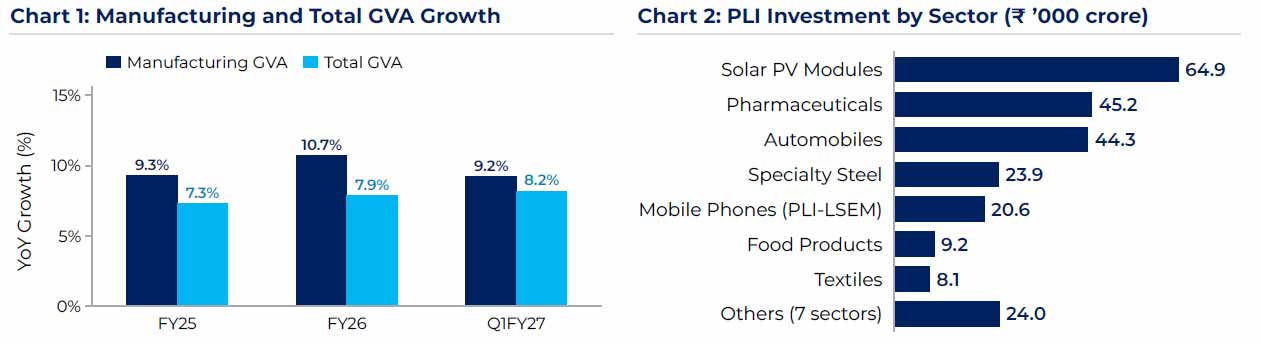
Source: MoSPI, PIB, Lok Sabha. Chart 1: Real GVA growth YoY at constant prices; Q1FY27 is April-June 2026. Chart 2: Cumulative investment under the 14 PLI Schemes to March 2026, ₹ thousand crore.
What do Mobile Phones show?
143% Production vs target, Mar 2026 | More output for less incentive: The PLI Scheme for Large Scale Electronics Manufacturing (PLI-LSEM) beat its targets for investment (294%), production (143%) and exports (134%) by March 2026. As incentives were paid only on the increase in sales over a base year, it cost about ₹1.64 per ₹100 of output over FY21-FY26, against ₹4.20 planned. |
43% Share of PLI exports, Mar 2026 | High exports for the capital invested: By March 2026, phones had drawn 8.6% of PLI investment but delivered about 43% of PLI exports. They became India's largest export product in FY26, with exports of ₹2.60 lakh crore, about 165 times the FY15 level, and 99.2% of phones used in India were made locally in 2026. |
2.25-5% Incentive on eligible sales | The next phase: The MPMS, approved in July 2026, runs till FY31 and expects production of about ₹39 lakh crore over FY27-FY31. It pays 2.25% to 5% of eligible sales only if sales rise by at least ₹5,000 crore a year, with up to 1.5% more for local components and a separate track for Indian brands. |
What could deepen India’s Manufacturing Base?
Reducing reliance on imported components
Electronic goods imports rose 45.0% YoY to US$ 81.3 billion in April-September 2026, in line with exports, suggesting much of the export value is still imported.
Making more of each product in India
Domestic value addition in phones rose from about 15% at the start of the PLI Scheme to about 23% in FY24. At FY26 output of ₹6.27 lakh crore, each further percentage point would add about ₹6,300 crore a year of value made in India.
Building a local supply of parts and chips
By July 2026, 75 component projects worth ₹61,671 crore and 12 semiconductor units (3 in production) had been approved, and Semicon 2.0 added ₹1.27 lakh crore in July 2026.
Conclusion
Real manufacturing GVA grew 10.7% YoY in FY26 and contributed about 21% of India’s GVA growth. The PLI Schemes have added investment, exports and jobs across 14 sectors, and electronics were the largest source of growth in merchandise exports in FY26.
Mobile phones show what this approach could achieve, with output and exports above target over FY21-FY26 at less than half the planned incentive cost per unit. The variables to watch are domestic value addition, the approved component and semiconductor projects, and the ramp-up of capital- intensive PLI sectors.
If these progress as planned, manufacturing could raise its share of India’s output, exports and employment, making India’s growth potentially stronger and more resilient.
Sources: Union Cabinet, MeitY, MoSPI, PIB, Lok Sabha, DGCI&S, RBI and other publicly available information.
About Tuesday’s Talking Point (TTP): TTP is an effort by HDFC AMC to guide key conversations in the Indian financial markets and investing ecosystem. We aspire to do this by providing relevant facts, along with our perspective on the issue at hand. Please provide your feedback at this link: https://forms.office.com/r/Cr8JNjMGWk
Disclaimer: Views expressed herein are based on information available in publicly accessible media, involve known and unknown risks and uncertainties that could cause actual results, performance, or events to differ materially from those expressed or implied herein. The information herein is for general purposes only. Stocks/Sectors/Views referred are illustrative and should not be construed as an investment advice or a research report or a recommendation by HDFC Mutual Fund (“the Fund”) / HDFC Asset Management Company Limited (HDFC AMC) to buy or sell the stock or any other security. HDFC AMC is not indicating or guaranteeing returns on any investments. Past performance may or may not be sustained in the future and is not a guarantee of any future returns. The recipient(s), before taking any decision, should make their own investigation and seek appropriate professional advice.
MUTUAL FUND INVESTMENTS ARE SUBJECT TO MARKET RISKS, READ ALL SCHEME RELATED DOCUMENTS CAREFULLY.
Stay ahead with our insights
Did you find this interesting?
Your opinion matters - share your thoughts and help us improve.