- Entering text into the form field will trigger a list of options
Trending Searches
- Invest / Login
India’s Push for Home-Grown Energy Gathers Pace

Last Updated On: 27 Oct 2026
5 min read
What’s the Point?
- Non-fossil sources crossed half of India’s installed power capacity in 2025, five years ahead of the 2030 target, and reached 55% by September 2026. Renewables made up 88% of the capacity added in FY26.
- The Middle East’s share of India’s crude oil imports fell from 64% in FY22 to 49% in FY26 as India diversified its suppliers.
- The government approved ₹1.86 trillion in September 2026 for transmission lines within states, to connect 135 GW of renewable capacity by March 2033.
India imports 89% of its crude oil and about half of its natural gas, which has long made energy security a policy priority. Over the past decade India has widened its supply base, built strategic reserves and scaled up clean power: non-fossil sources made up 55% of installed power capacity in September 2026 and supplied 32% of the electricity generated in April to August 2026. The West Asia conflict began in February, and the steps taken since then aim to reduce the need for imported fuel.
1) Coal and renewables are largely domestic; oil and gas depend on imports
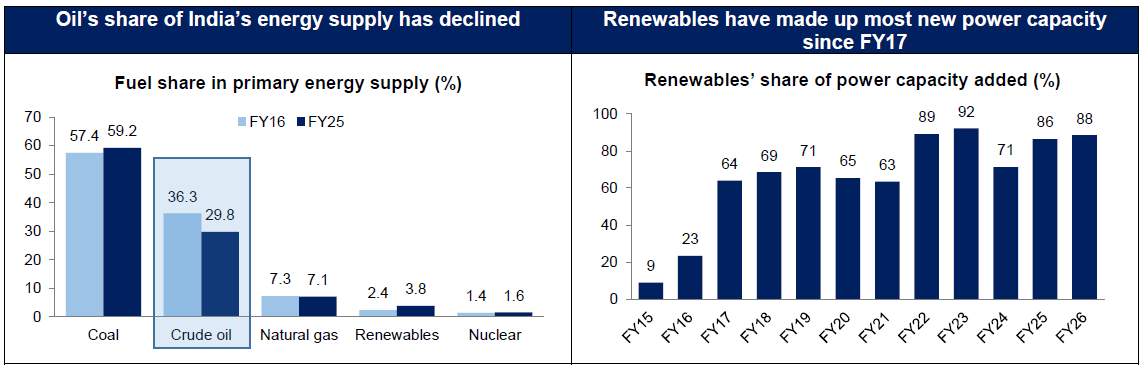
Domestic sources are gaining share: Coal supplied 59% of India’s primary energy in FY25, the latest year available, and crude oil 30%, with natural gas at 7%. Oil’s share has fallen from 36% in FY16, while renewables have risen from 2.4% to 3.8%. Coal is largely mined at home, and its import dependence has eased to 23.5% from 27.3% in FY16.
Imports are concentrated in oil and gas: Import dependence was 88.7% for crude oil in FY26 and about 50% for natural gas, while 64% of LPG, the main cooking fuel, was imported in FY26. Electricity though is generated mostly from domestic coal, hydro and renewables, so shifting demand from oil and gas to electricity, as electric vehicles do, reduces imports.
Rising demand, met mostly at home: Energy needs are growing with the economy. Manufacturing is expanding, rising incomes are lifting consumption and more homes are buying air conditioners, while electric vehicles and data centres are adding to power demand. Peak power demand reached a record 271 GW in May 2026 and was 269 GW in September, up from 229 GW a year earlier. Total primary energy supply rose 38% between FY16 and FY25, and over 70% of that increase came from coal and renewables, both largely domestic.
2) India has been widening its energy base for years
Less reliance on the Middle East: The Middle East supplied 64% of India’s crude oil imports in FY22 but 49% in FY26, as Russia’s share rose from 2% to 30%, with the US, West Africa and Latin America supplying most of the rest. Refining capacity rose to 267 million tonnes a year in April 2026 from 215 million in 2015, and India remains a net exporter of petroleum products.
Reserves built, ethanol at 20%: Strategic petroleum reserves at three sites can hold 5.33 million tonnes of crude, enough for about 9.5 days of India’s crude oil needs. A second phase adding 6.5 million tonnes was approved in 2021, and a further 1.75 million tonne reserve at Mangaluru received in-principle approval in July 2026. Ethanol blending in petrol rose from 1.5% in 2013-14 to 20% in October 2025 and has averaged about 20% since, replacing part of imported crude with a domestic, farm-based fuel.
Most new capacity is renewable: Solar alone made up 31% of installed power capacity in September 2026, and wind 11%. Renewables accounted for 88% of the power capacity added in FY26. Renewable energy investment of $15.4 billion was committed in the first half of 2026.
3) India is moving faster to replace imported fuel
Electrifying transport cuts oil imports: Diesel and petrol make up 55% of the oil products India uses, most of it in transport, so this is where electrification cuts imports most directly. Electric vehicles on Indian roads already replaced about 89,000 barrels of oil a day in 2025, around 4% of the country’s oil demand. Adoption has picked up since the conflict began: the electric share of two-wheeler sales rose from 6.7% in January to 10.7% in August 2026. Fleet electrification, wider charging networks and easier finance are the next steps.
Domestic substitutes for gas and LPG: A 2026 policy guarantees buyers for compressed biogas, made from farm and city waste, for use as vehicle fuel and piped gas. Green hydrogen, made with renewable power, will replace part of the imported gas used to make fertiliser: 11 of the 14 supply contracts signed in January to April 2026 are with fertiliser makers. Domestic LPG output has also been raised by about 25%.
Grids and storage to carry clean power: Transmission is now the focus, so that new generation reaches consumers. The third phase of the Green Energy Corridor, approved in September with ₹1.86 trillion, will strengthen networks within states to connect 135 GW of renewable capacity by March 2033. New lines will be awarded through competitive bidding to private developers, who will build, own, operate and maintain them, while upgrades to existing networks will be done on a cost-plus basis. Private developers have already won nearly half of the national grid projects due in FY27. Since the second half of 2025, solar or wind projects with four-hour batteries, which keep supplying power after sunset, are estimated to produce electricity more cheaply than a new coal plant.
Conclusion
India had been strengthening its energy security well before the West Asia conflict, and it has done more since. The variables to watch are the pace of electric vehicle adoption, which sets how fast oil demand eases; how quickly transmission lines and batteries are added to carry solar and wind power to consumers and store it for the evening; and the expansion of strategic reserves, which adds a buffer against supply shocks.
Sources: MoSPI, CEA, CMIE, PPAC, Ministry of Power, Ministry of New and Renewable Energy, Ministry of Petroleum and Natural Gas, BloombergNEF and other publicly available information.
Disclaimer: Views expressed herein are based on information available in publicly accessible media, involve known and unknown risks and uncertainties that could cause actual results, performance, or events to differ materially from those expressed or implied herein. The information herein is for general purposes only. Stocks/Sectors/Views referred are illustrative and should not be construed as an investment advice or a research report or a recommendation by HDFC Mutual Fund (“the Fund”) / HDFC Asset Management Company Limited (HDFC AMC) to buy or sell the stock or any other security. HDFC AMC is not indicating or guaranteeing returns on any investments. Past performance may or may not be sustained in the future and is not a guarantee of any future returns. The recipient(s), before taking any decision, should make their own investigation and seek appropriate professional advice.
MUTUAL FUND INVESTMENTS ARE SUBJECT TO MARKET RISKS, READ ALL SCHEME RELATED DOCUMENTS CAREFULLY.
Stay ahead with our insights
Did you find this interesting?
Your opinion matters - share your thoughts and help us improve.