
- Entering text into the form field will trigger a list of options
Trending Searches
- Invest / Login
Monsoon 2026 ends below normal, but rural India has more buffers than before

Last Updated On: 6 Oct 2026
5 min read
What’s the Point?
- Monsoon rainfall ended about 13% below normal, yet kharif sowing is only 1.4% lower than last year, with pulses and coarse cereals ahead.
- The 2026 monsoon ended below normal, but sowing, irrigation, reservoirs in the central and western belts and food stocks limit the impact on output and prices.
- In September-26, tractor registrations grew ~14% and two-wheeler registration ~30% year on year indicating that rural economy has held up well so far.
India's southwest monsoon is ending about 13% below the long period average, a deficit year as El Niño had signalled. The shortfall has not produced a sowing shock. Kharif acreage is 1.4% lower than last year, reservoirs hold 71% of live capacity and rural demand indicators remain positive. The weakness is concentrated in the South and East, while Central India, which anchors much of the kharif crop, has fared better. With the season withdrawing, attention shifts to rabi sowing, food prices and the upcoming RBI policy.
A deficit season with a resilient crop base
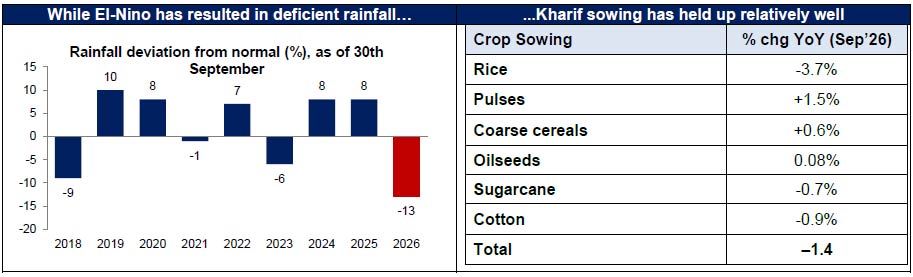
Rainfall: Cumulative rainfall is 13% below normal as of 30th September, against 8% above normal in 2025.
Regional spread: The shortfall is uneven though. Central India, home to much of the core kharif belt, is only about 5% below normal, against roughly 20%+ below normal in the South and East/Northeast.
Sowing: Above-normal rains in July let sowing catch up, and total kharif acreage is only 1.4% lower than last year. Pulses (+1.5%) and coarse cereals (+0.6%) are higher and oilseeds are flat. Within these, urad acreage is up 11.9% and jowar (+9.4%) and bajra (+3.3%) have gained, as farmers adjusted crop choice to the rain. Rice, down 3.7%, is the soft spot.
Buffers are stronger than in earlier deficit years
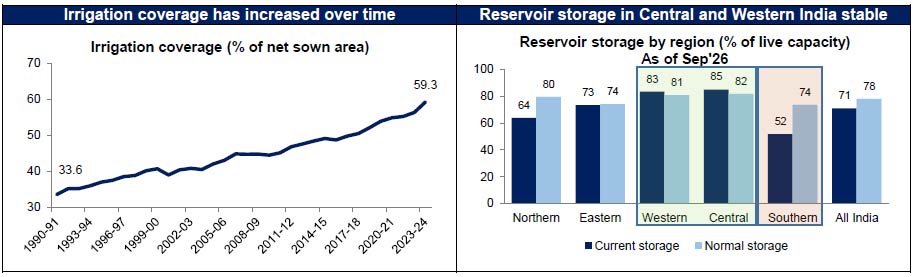
Water: Reservoirs hold 71% of live capacity, below normal overall, but Central and Western India are at or above normal and 115 of 178 reservoirs are above 80% of their normal storage. The South, at 52% of live capacity, is the region under stress. Uttar Pradesh and Chhattisgarh, two large rice-growing states, have reservoirs 28% and 14% above normal. Soil moisture is at or above the 10-year average in Uttar Pradesh, Chhattisgarh, Odisha, Jharkhand and eastern Madhya Pradesh, which supports crop development.
Irrigation: Irrigated area has risen to about 60% of net sown area in 2024-25 from 48.8% in 2015-16, so more of the crop now depends on canals and wells than on the rain. Farmers have also moved towards shorter-duration, drought-tolerant crops such as pulses, millets and oilseeds.
Food stocks: Central pool foodgrain stocks stood at 870 lakh tonnes on 1 September 2026, nearly three times the buffer norm, While, a part is committed to the public distribution system, the stock gives room to release supplies if prices rise.
Rural demand is holding up and inflation is manageable
Diversified incomes: Rural households are less tied to the crop cycle. Livestock, fisheries and forestry account for over 40% of agriculture and allied output, which has historically been steadier in weak monsoon years. Support measures add to this: PM-KISAN pays eligible farmers Rs 6,000 a year, and cash-transfer schemes operate in 17 states.
Inflation and policy: Headline CPI inflation was 4.82% in August, within the RBI's 2–6% tolerance band, with food inflation at 5.95%. Rural inflation, at 5.2%, is above urban at 4.3%. The upcoming RBI policy will weigh food and crude prices alongside the El Niño outlook
Conclusion
The 2026 monsoon ended below normal, but sowing, irrigation, reservoirs in the central and western belts and food stocks limit the impact on output and prices. The variables to watch are post-monsoon rainfall, which will decide rabi sowing in the water-stressed South and North; and food prices, where rice is the item to track. On balance, rural India enters the rabi season with buffers that have so far absorbed the shortfall, and demand indicators that remain positive.
Sources: IMD, Motilal Oswal, MoSPI, FCI, RBI and other publicly available information.
Disclaimer: Views expressed herein are based on information available in publicly accessible media, involve known and unknown risks and uncertainties that could cause actual results, performance, or events to differ materially from those expressed or implied herein. The information herein is for general purposes only. Stocks/Sectors/Views referred are illustrative and should not be construed as an investment advice or a research report or a recommendation by HDFC Mutual Fund (“the Fund”) / HDFC Asset Management Company Limited (HDFC AMC) to buy or sell the stock or any other security. HDFC AMC is not indicating or guaranteeing returns on any investments. Past performance may or may not be sustained in the future and is not a guarantee of any future returns. The recipient(s), before taking any decision, should make their own investigation and seek appropriate professional advice.
MUTUAL FUND INVESTMENTS ARE SUBJECT TO MARKET RISKS, READ ALL SCHEME RELATED DOCUMENTS CAREFULLY.
Stay ahead with our insights
Did you find this interesting?
Your opinion matters - share your thoughts and help us improve.