
- Entering text into the form field will trigger a list of options
Trending Searches
- Invest / Login
India’s Comfortable External Balances Situation even as Crude crosses US$100

Last Updated On: 15 Sep 2026
5 min read
What’s the Point?
- Brent Crude has risen 35.4% to US$107.44 per barrel (/bbl) between 05-Aug-26 (local minima) and 15-Sep-26 amidst a renewed escalation in the US/Israel-Iran conflict. Despite that, India’s Current and Capital Accounts remain resilient, cushioned by strong invisibles, fresh FCNR(B) inflows and record forex reserves.
- In Q1FY27, India’s Current Account Deficit (CAD) stood just 0.5% of GDP, as services exports and remittances covered most of the goods trade deficit. Even a sustained rise in Brent from the current to an average level of US$100/bbl in FY27, could keep CAD at manageable levels.
- India’s Capital Account – which weakened sharply in FY26 – is set to strengthen in FY27 against a Capital Account surplus of US$6.0 billion in FY26, as banks have mobilised US$127.2 billion of FCNR(B) deposits under the RBI’s USDINR swap facility as on August 31, 2026. Healthy record forex reserves to the tune of US$740.8 billion (as of August 28, 2026) also provide comfort about India’s external resiliency amidst heightened uncertainty.
The Indian Basket of crude oil crossed US$100/bbl on September 04, 2026, touching US$101.07/bbl – its highest level since May 2026 – as the conflict in West Asia intensified. As India imported 88.7% of its crude oil requirement in FY26, imports of petroleum, oil and lubricants (POL) rose to US$60.6 billion in Q1FY27 from US$49.2 billion a year earlier, widening the net POL deficit to US$37.6 billion from US$32.2 billion.
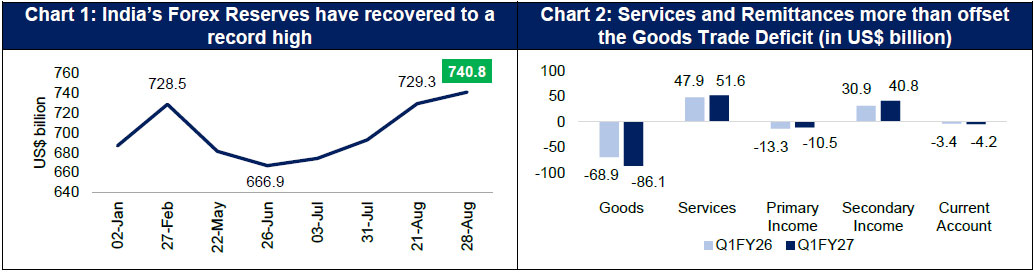
Source: RBI Weekly Statistical Supplement; RBI BOP release, September 01, 2026. Chart 1: Reserves for the week ended on the date shown (2026). Chart 2: Net balances; negative values denote deficits; secondary income mainly comprises remittances; Q1FY26 partially revised, Q1FY27 preliminary.
Current Account – CAD likely to remain manageable
Net invisibles, led by services exports and remittances, have covered a steadily rising share of India’s goods trade deficit – from 55% in FY13 to 92% in FY26 – reaching 95% in Q1FY27 and keeping the CAD at just 0.5% of GDP (Table 1). Merchandise exports have also picked up meaningfully, rising 17.0% Year-over-Year (YoY) to US$173.78 billion in April- July 2026 (Ministry of Commerce and Industry).
As of FY26, CAD as a percentage of GDP sat at 0.6%. As per RBI, every US$10/bbl rise in crude oil prices adds about 0.5 percentage points to the CAD. On this basis, an increase in average Brent Crude Oil from US$69.04/bbl in FY26 to US$100/bbl could take the CAD to about ~2.1% of GDP in FY27, which is still manageable compared to earlier periods of pressure (Table 1).
Capital Account – FCNR(B) Inflows to strengthen the position in FY27
The Capital Account was the main source of pressure in FY26, with the surplus falling to US$6.0 billion from US$89.5 billion in FY24 as FPI (Foreign Portfolio Investors) flows turned negative (Table 1). However, the tide has started to turn in FY27 with the RBI’s USD-INR swap facility (introduced on June 08, 2026). Since Q1FY27, banks mobilised US$127.2 billion of FCNR(B) deposits under the RBI’s swap facility (June 08-August 31, 2026), with total inflows under the facility reaching US$136.4 billion. As a result, these inflows lifted India’s forex reserves to a record US$740.8 billion as of August 28, 2026.
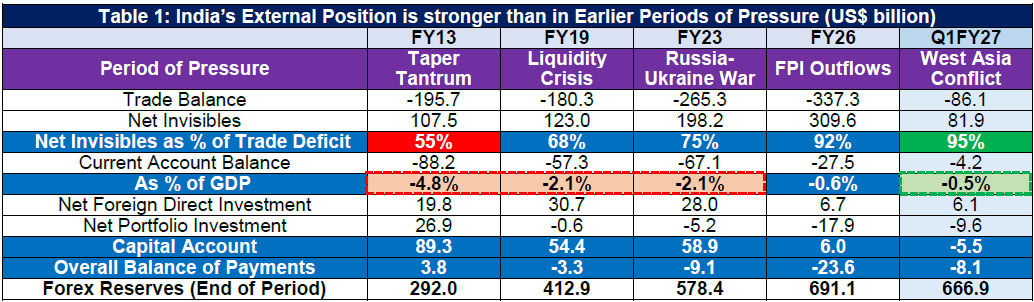
Source: RBI, CEIC. FY13-FY26: RBI quarterly data may differ from RBI annual releases owing to revisions (RBI reports the FY26 CAD at 0.6% of GDP). Q1FY27: RBI release of September 01, 2026 (preliminary); Capital Account excludes reserve assets.
Conclusion
India’s External Accounts seem to be remain comfortable on both the Current and Capital Accounts despite the recent disruptions, supported by structural factors that have reduced the potential sensitivity of the Indian economy to oil:
- Crude oil imports have fallen from about 8.5% of GDP in 2012 to about 4.8% in 2025, and short-term external debt from 33.1% to 21.6% of forex reserves between March 2013 and March 2026.
- The CAD remains well below earlier periods of pressure, backed by US$127.2 billion of FCNR(B) inflows, record forex reserves and a resilient banking system (RBI Financial Stability Report, June 2026).
- The RBI estimates a 10% rise in crude prices would add 30 bps to inflation and cut growth by 15 bps, which is a manageable impact given these buffers.
The key risks of a prolonged period of crude > US$100/bbl are: (1) widening CAD, (2) higher inflation, (3) lower USD-INR exchange rate, (4) slower remittances from Middle East (38% of India’s total), and (5) pressure on Capital Account through FPI outflows. With FCNR(B) deposits repayable on maturity, continued growth in services exports and FDI remains key.
Crude oil prices have already proved volatile through 2026, with Brent having fallen by 38.6% from US$118.35/bbl in March to US$72.63/bbl by June 2026 after the US-Iran Memorandum of Understanding, and rising up again to cross US$100/bbl again in September 2026 as tensions resurfaced. While such swings could continue if the conflict persists, India’s external position seems far better placed to absorb them than in past episodes of stress, backed by a decade of falling oil intensity, deepening invisibles, stronger reserves and renewed capital inflows.
Sources: RBI, Ministry of Commerce and Industry, PPAC, Ministry of Petroleum and Natural Gas, Ministry of Finance, CEIC, and other publicly available information.
About Tuesday’s Talking Point (TTP):
TTP is an effort by HDFC AMC to guide key conversations in the Indian financial markets and investing ecosystem. We aspire to do this by providing relevant facts, along with our perspective on the issue at hand. Please provide your feedback at this link: https://forms.office.com/r/Cr8JNjMGWk
Disclaimer: Views expressed herein are based on information available in publicly accessible media, involve known and unknown risks and uncertainties that could cause actual results, performance, or events to differ materially from those expressed or implied herein. The information herein is for general purposes only. Stocks/Sectors/Views referred are illustrative and should not be construed as an investment advice or a research report or a recommendation by HDFC Mutual Fund (“the Fund”) / HDFC Asset Management Company Limited (HDFC AMC) to buy or sell the stock or any other security. HDFC AMC is not indicating or guaranteeing returns on any investments. Past performance may or may not be sustained in the future and is not a guarantee of any future returns. The recipient(s), before taking any decision, should make their own investigation and seek appropriate professional advice.
MUTUAL FUND INVESTMENTS ARE SUBJECT TO MARKET RISKS, READ ALL SCHEME RELATED DOCUMENTS CAREFULLY.
Stay ahead with our insights
Did you find this interesting?
Your opinion matters - share your thoughts and help us improve.