- Entering text into the form field will trigger a list of options
Trending Searches
- Invest / Login
GST Reforms could extend support for India’s Consumption-led Growth

Last Updated On: 13 Oct 2026
5 min read
What’s the Point?
- At its 57th meeting on October 8, 2026, the Goods and Services Tax (GST) Council recommended measures to make GST easier and less costly to comply with, including faster refunds, wider input tax credit, simpler filing and fewer tax disputes.
- This builds on last year’s reduction in GST rates and adds to the Government’s measures to raise household spending. As we enter the festive season, the GST measures could act as a tailwind for discretionary spending.
- Private consumption has grown faster than a year earlier in every quarter since the tax reductions, even as global energy prices rose. In September 2026, vehicle registrations rose 31.9% Year-over-Year (YoY) and e-way bills reached a record high. Strong domestic demand supports tax revenues and encourages businesses to invest, leaving the economy better placed to absorb external shocks.
What has the GST Council recommended?
The GST Council, chaired by the Union Finance Minister and including State Finance Ministers, held its 57th meeting in New Delhi on October 8, 2026. At its previous meeting in September 2025, the Council had reduced the number of main GST rates from four to two. With the new rate structure in place for a year, the Council has now focused on how GST is administered – registration, return filing, refunds and disputes. The key recommendations are:
- Faster refunds: Refunds to be sanctioned automatically, easing working capital for businesses.
- Lower business costs: Input tax credit to be allowed on more items, such as health and life insurance.
- Simpler compliance: Most registration changes to be accepted automatically, fewer tax notices and the power of arrest to be removed.
India’s Current Standing
India’s Real GDP grew 7.8% YoY in April-June 2026, compared with 6.9% YoY a year earlier, with Private Final Consumption Expenditure (PFCE), which accounts for about 56% of GDP, growing 7.1% YoY. In its Monetary Policy Review on October 7, 2026, the Reserve Bank of India (RBI) said strong private consumption and investment had supported this growth, noted continued momentum in domestic economic activity in July-August 2026, and projected Real GDP growth of 7.1% YoY for FY27 as against the previous estimate of 6.7% YoY.
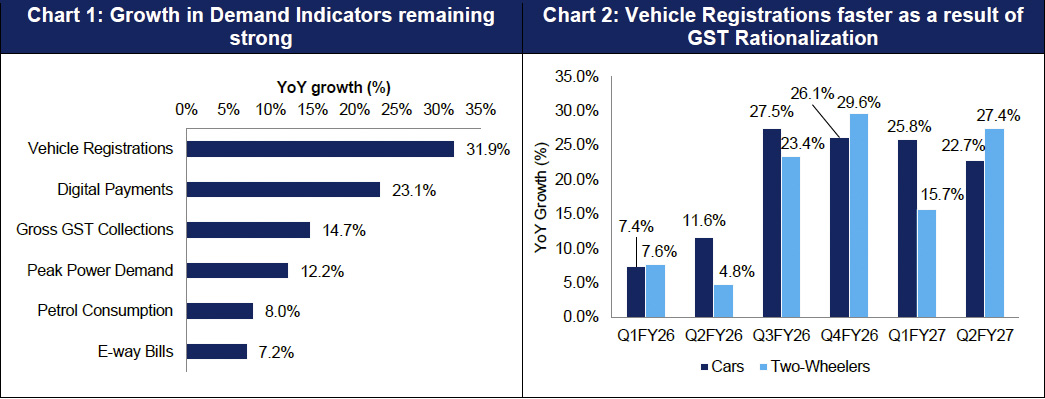
Source: GSTN, RBI, PPAC, CEA, Ministry of Road Transport and Highways (Vahan). Chart 1: September 2026 except digital payments and peak power demand (August 2026). Chart 2: Quarterly YoY growth in new non-transport vehicle registrations; Cars: Light Motor Vehicles.
How has the Government supported Consumption?
The Government has used tax policy to raise household spending power:
- Lower income tax: The Union Budget 2025-26 made income up to ₹12 lakh free of income tax under the new tax regime, leaving about ₹1 lakh crore more with households to spend or save.
- Lower GST rates: From September 22, 2025, the GST Council simplified the tax structure to two main rates of 5% and 18%, lowering the tax on a wide range of everyday goods, consumer durables, medicines and insurance. Retail inflation averaged 0.8% in October-December 2025, the first quarter after the reduction, compared with 2.2% in April-September 2025.
- Higher spending: Private consumption grew 8.2% YoY in October-December 2025, the first full quarter after the GST reduction, compared with 6.0% YoY a year earlier. This number has kept growing faster than a year earlier since then. Vehicle registrations rose 17.0% YoY in FY26.
What do High Frequency Indicators show?
- Vehicle Registrations: 25.5 lakh vehicles were registered in September 2026, up 31.9% YoY from a low base.
- Movement of Goods: A record 141.5 million e-way bills were generated in September 2026, up 7.2% YoY.
- GST Collections: ₹2.04 lakh crore was collected in September 2026, up 14.7% YoY, and domestic collections for April-September 2026 rose 6.1% despite lower rates.
- Digital Payments: The value of digital payments rose 23.1% YoY in August 2026, with transactions up 19.7%.
- Fuel and Power: Petrol use rose 8.0% YoY in September 2026, and peak power demand 12.2% in August.
Conclusion
Since early 2025, the Government has used tax policy to raise household spending, first through lower income tax in the Union Budget 2025-26 and then through lower GST rates from September 2025. Households have responded, with private consumption growing faster than a year earlier in every quarter, and with vehicle registrations growing healthily and e-way bills at a record high in September 2026.
The 57th GST Council meeting extends this support from households to businesses by lowering the cost of complying with GST, which may help them grow and invest. With consumption, investment and tax collections all rising, and the RBI projecting Real GDP growth of 7.1% YoY in FY27, India’s growth rests on a broad base of domestic demand, leaving the economy well placed to sustain its momentum through periods of global uncertainty.
Sources: GST Council, PIB, Union Budget, Ministry of Finance, MoSPI, RBI, GSTN, Ministry of Road Transport and Highways (Vahan), PPAC, CEA, and other publicly available information.
About Tuesday’s Talking Point (TTP): TTP is an effort by HDFC AMC to guide key conversations in the Indian financial markets and investing ecosystem. We aspire to do this by providing relevant facts, along with our perspective on the issue at hand. Please provide your feedback at this link: https://forms.office.com/r/Cr8JNjMGWk
Disclaimer: Views expressed herein are based on information available in publicly accessible media, involve known and unknown risks and uncertainties that could cause actual results, performance, or events to differ materially from those expressed or implied herein. The information herein is for general purposes only. Stocks/Sectors/Views referred are illustrative and should not be construed as an investment advice or a research report or a recommendation by HDFC Mutual Fund (“the Fund”) / HDFC Asset Management Company Limited (HDFC AMC) to buy or sell the stock or any other security. HDFC AMC is not indicating or guaranteeing returns on any investments. Past performance may or may not be sustained in the future and is not a guarantee of any future returns. The recipient(s), before taking any decision, should make their own investigation and seek appropriate professional advice.
MUTUAL FUND INVESTMENTS ARE SUBJECT TO MARKET RISKS, READ ALL SCHEME RELATED DOCUMENTS CAREFULLY.
Stay ahead with our insights
Did you find this interesting?
Your opinion matters - share your thoughts and help us improve.