
- Entering text into the form field will trigger a list of options
Trending Searches
- Invest / Login
India could hold its Fiscal Deficit Target despite the West Asia Conflict

Last Updated On: 29 Sep 2026
5 min read
What’s the Point?
- India’s Fiscal Deficit as a percentage of GDP has fallen every year since FY21 – from 9.2% to 4.4% in FY26, and the Union Budget 2026-27 aims for 4.3% in FY27. The West Asia conflict has made imported crude oil, Liquefied Petroleum Gas (LPG) and fertilisers costlier. In addition to that, the cut in tax on petrol and diesel to keep pump prices stable, has raised the question of the ability of the Budget to absorb these costs.
- Thus far, the data suggests that the Budget has the ability to absorb the costs. Direct Tax collections and the pace of divestment are ahead of last year, and an Economic Stabilisation Fund has been set aside for such situations. Adhering to the fiscal deficit target would curb borrowing, stabilize interest rates and the Rupee, and protect infrastructure spending, thereby strengthening India’s resilience to external shocks.
India’s Current Standing
The Government met its FY26 target of 4.4% of GDP, according to early figures from the Controller General of Accounts (CGA), and has targeted a Fiscal Deficit of ₹16.96 lakh crore – or 4.3% of GDP – in FY27. At the end of the April-July 2026 period, the Fiscal Deficit stood at ₹4.55 lakh crore, which is 26.8% of the full-year target – lower than the 29.9% level for the same period last year. This is despite capital expenditure rising about 30% between April-July 2026 and April-July 2025. The constraint is on the spending side, with the Government already having utilised 37% of its yearly Budget for major subsidies during April-July 2026, compared with 30% a year earlier.
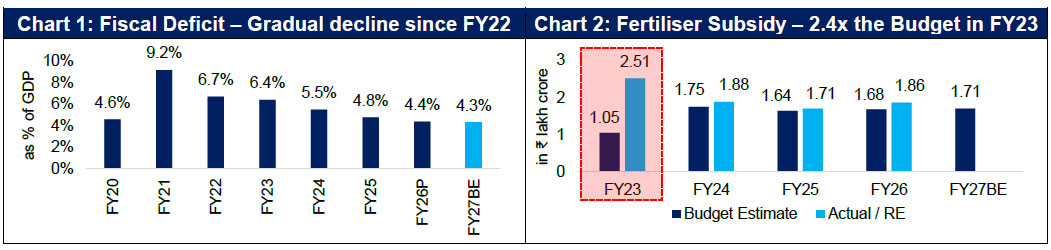
Source: Union Budget Documents, CGA. P: Provisional, BE: Budget Estimate, RE: Revised Estimate. FY26 shown at Revised Estimate.
What is adding to the Deficit?
India’s crude oil import price averaged US$90.19/bbl in August 2026, against US$69.11/bbl a year earlier, and reached US$123.86/bbl on September 18, 2026. Higher import prices are affecting the Budget predominantly in 3 ways:
- Fertiliser Subsidy is higher than planned: Prices of imported Urea, Diammonium Phosphate (DAP) and Potash rose after supplies from West Asia were disrupted. As of July 13, 2026, the Government had spent ₹70,709 crore on Fertiliser Subsidy, which is about 40% of the ₹1.77 lakh crore allocated for FY27. In FY23, during the Russia- Ukraine conflict, the Fertiliser Subsidy of ₹2.51 lakh crore was 2.4 times the ₹1.05 lakh crore planned. Hence, the Fertiliser Subsidy is likely to require additional allocation during FY27.
- LPG is being sold below its cost of supply: The Ministry of Petroleum and Natural Gas (MoPNG) informed the Parliament that the losses incurred by Public Sector Oil Marketing Companies (OMCs) on the sale of domestic LPG exceeded ₹51,000 crore as on June 30, 2026. As the Government has compensated OMCs for part of such losses in the past, an additional allocation could be required during FY27.
- Lower tax on petrol and diesel means lower income: The Government cut excise duty on petrol and diesel by ₹10 per litre from March 27, 2026. Excise duty collections fell by about 23% in April-July 2026 compared with the same period last year, whereas the Union Budget 2026-27 assumes a 15.6% increase for the full year. Hence, collections are likely to fall short of the planned ₹3.89 lakh crore.
What keeps the Deficit in check?
- Robust Direct Tax Collections: ₹12.12 lakh crore has been collected by 17-Sep-26 – up 12.96% Year-over- Year (YoY), with Corporate Advance Tax up 18.09% YoY.
- Higher Pace of Divestment: About 70% of the FY27 target achieved by end-August, with ₹55,757 crore raised against ₹80,000 crore budgeted from divestment and asset monetisation. This is already about 65% higher than the ₹33,837 crore raised in FY26RE, with the strategic divestment of IDBI Bank yet to be completed.
- Healthy Dividend from the RBI: ₹2.87 lakh crore has been paid to the Government for 2025-26, which is the highest level till date, compared with ₹2.69 lakh crore a year earlier.
In addition, the Government created a ₹1 lakh crore Economic Stabilisation Fund in March 2026 to provide fiscal headroom to respond to global headwinds, supply chain disruptions and unexpected shocks to sectors of the economy. Of this, ₹57,381 crore was approved by Parliament in March 2026 as additional spending for FY26, and the remaining ₹42,619 crore is to come from savings of other ministries. Customs duty collections have also risen about 38% between April-July 2026 and April-July 2025, after the Government raised import duty on gold and silver.
What if the Deficit rises further?
In FY26, the Government spent about ₹1 lakh crore less than planned, mainly on schemes run jointly with states, and still met its 4.4% target even after Parliament approved ₹2.01 lakh crore of extra spending. A similar review in FY27 could save money without cutting infrastructure spending. Based on the Union Budget’s estimate of nominal GDP for FY27, 0.1% of GDP is about ₹39,000 crore. Hence, higher income and spending savings could offset a moderate rise in subsidies and limit any overshoot. The borrowing plan for October 2026-March 2027, announced on 25-Sep-26, keeps net market borrowing at the budgeted ₹11.73 lakh crore, indicating no plan to borrow more for a wider deficit.
Conclusion
Since FY21, India has more than halved its Fiscal Deficit, and FY27 is testing whether this progress can hold through an external shock. Stronger tax collections, higher non-tax receipts and the Economic Stabilisation Fund give the Government the means to absorb higher energy and fertiliser costs without reversing course. Keeping the Fiscal Deficit close to target would limit borrowing, support financial stability and keep India on track towards the 3.5% of GDP recommended by the Sixteenth Finance Commission for 2030-31.
Sources: RBI, PIB, Union Budget, Ministry of Finance, CGA, Income Tax Department, Department of Investment and Public Asset Management, MoPNG, PPAC, Sixteenth Finance Commission, Ministry of Chemicals and Fertilizers, and other publicly available information.
About Tuesday’s Talking Point (TTP): TTP is an effort by HDFC AMC to guide key conversations in the Indian financial markets and investing ecosystem. We aspire to do this by providing relevant facts, along with our perspective on the issue at hand. Please provide your feedback at this link: https://forms.office.com/r/Cr8JNjMGWk
Disclaimer: Views expressed herein are based on information available in publicly accessible media, involve known and unknown risks and uncertainties that could cause actual results, performance, or events to differ materially from those expressed or implied herein. The information herein is for general purposes only. Stocks/Sectors/Views referred are illustrative and should not be construed as an investment advice or a research report or a recommendation by HDFC Mutual Fund (“the Fund”) / HDFC Asset Management Company Limited (HDFC AMC) to buy or sell the stock or any other security. HDFC AMC is not indicating or guaranteeing returns on any investments. Past performance may or may not be sustained in the future and is not a guarantee of any future returns. The recipient(s), before taking any decision, should make their own investigation and seek appropriate professional advice.
MUTUAL FUND INVESTMENTS ARE SUBJECT TO MARKET RISKS, READ ALL SCHEME RELATED DOCUMENTS CAREFULLY.
Stay ahead with our insights
Did you find this interesting?
Your opinion matters - share your thoughts and help us improve.