
- Entering text into the form field will trigger a list of options
Trending Searches
- Invest / Login
The FCNR(B) Wave: How Inflows can re-anchor Rupee Stability!

Last Updated On: 8 Sep 2026
5 min read
What’s the Point?
- The RBI’s June 2026 Forex Swap facility has pulled in $136.38 bn, led by a bumper $127.22 bn FCNR(B) mobilisation as of August 31, 2026. This is almost ~5x the amount raised under the RBI's 2013 FCNR(B) swap scheme, which had raised ~$26 bn.
- Since the policy rollout, FX reserves have climbed to a record $740.8 bn (as on Aug 28, 2026), while USDINR has held a tight range despite global volatility.
- The recent rally in money market yields, post release of FCNR(B) mobilisation data, reflects resilience amid elevated crude oil prices, a hawkish Fed and global long-end bond yields at multi-year highs.
The rupee faced depreciation pressure through H1 2026, against a backdrop of broad-based dollar strength, higher crude oil prices due to the West Asia conflict and higher global bond yields. Against that backdrop, the Reserve Bank announced a comprehensive package of measures to stabilize the rupee in June 2026. Some of the key measures included bearing the full hedging cost for raising fresh 3–5-year Foreign Currency Non-Resident Bank [FCNR (B)] deposits by Authorized Dealers, expanding the universe for G-Secs under the Fully Accessible Route (FAR) along with the Government providing tax benefits on G-Secs and incentivizing External Commercial Borrowings (ECBs) by Public Sector Undertakings.
How much forex inflows have the RBI’s June 2026 policy measures helped collect?
Cumulative inflows under the RBIs Forex Swap facility reached $136.38 billion by August 31, 2026 — $127.22 bn of FCNR(B) deposits, $5.26 bn of overseas foreign currency borrowings (OFCBs) and $3.89 bn of external commercial borrowings (ECBs). This FCNR(B) collection is almost ~5x the amount raised under the RBI's 2013 FCNR(B) swap scheme, which had raised ~$26 bn. The bond market measures also produced a positive response. FPIs bought a net Rs. 72,722 crores (~$7.6 bn) of Indian debt across June - August 2026. (Source: NSDL, internal calculations)
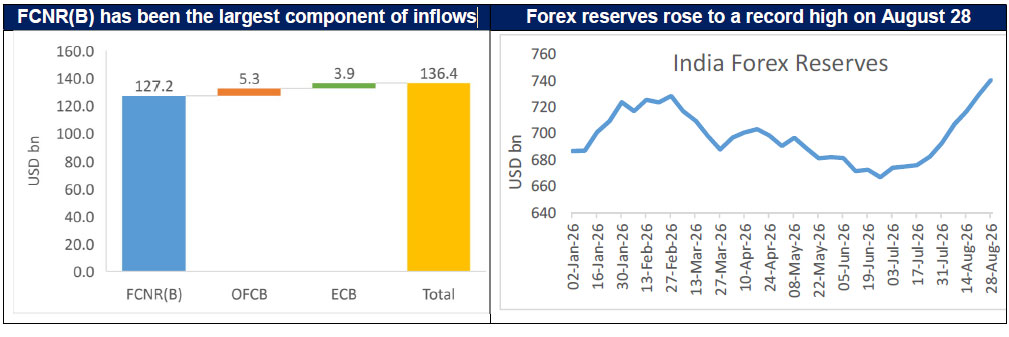
Source: RBI, PIB, internal calculations. Provisional FCNR(B) data as of Aug 31, 2026. Forex data as of Aug 28, 2026
The rupee has remained stable and foreign exchange reserves reached a record high against a challenging macro backdrop
Thanks to these measures, the rupee (USDINR) stabilized and has remained in a range of Rs. 94.33–96.57. Foreign exchange reserves rose to a record $740.8 bn by August 28, up from their low of the year of $666.9 bn in the week ended June 26.
These outcomes are particularly noteworthy because of the difficult environment in which they were achieved. The West Asia conflict continues albeit at reduced intensity, and oil and commodity flows through the Strait of Hormuz have not yet fully normalised. The global financial backdrop also remains challenging. Long-end government bond yields across developed markets are at or near multi-year highs. Federal Reserve Chair Kevin Warsh sharpened his inflation warning at Jackson Hole on August 28 — fuelling market expectations of a possible rate increase rather than a cut.
Money market yields have eased sharply in response to robust FCNR(B) collections
The RBI’s Forex Swap facility has resulted in banking system surplus liquidity, and the robust collections under the FCNR(B) scheme have helped contribute to a sharp rally in the money market yields. The RBI is also taking steps to manage this excess liquidity. For example, an overnight variable rate reverse repo (VRRR) auction on September 3 mopped up Rs. 5.19 lakh crores. Given the challenging global environment, having surplus liquidity in the banking system is a relatively favourable situation to face. In earlier episodes of currency pressure, defending the rupee has typically meant tightening domestic liquidity and raising rates, with the cost passed on to domestic borrowers. This time the currency has been supported by attracting inflows so liquidity is in surplus rather than deficit, and the RBI is looking to dynamically manage surplus liquidity conditions. Ample liquidity helps keeps funding conditions relatively manageable for banks and borrowers at a time when the external environment is unfavourable.
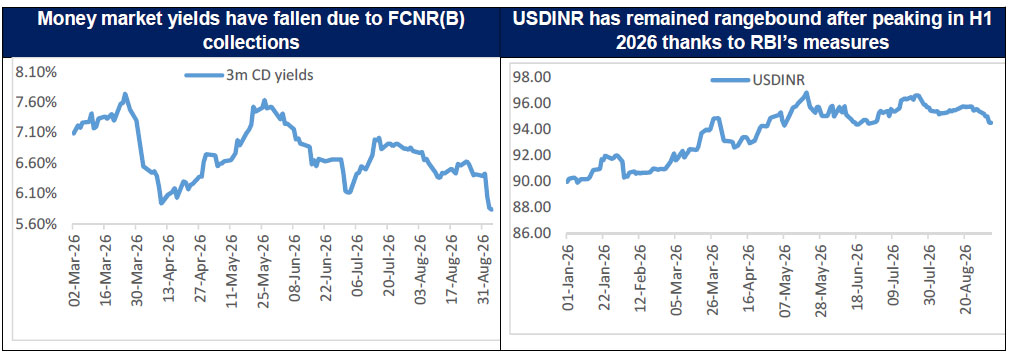
Source: Bloomberg, internal calculations
Conclusion
India is navigating one of the most challenging external backdrops in recent years — volatile oil prices, multi-year highs in global long-end yields, and a US Fed indicating potential further tightening. Yet, the RBI’s well-calibrated measures have helped stabilise the rupee through an exceptional FCNR(B) mobilisation of $127.22 bn — nearly five times the 2013 programme – and also helped rebuild reserves to a new high. This surge in foreign currency deposits has been central to keeping domestic yields contained, restoring confidence, and ensuring abundant liquidity at a time when global conditions remain uncertain. Policymakers continue to remain vigilant of risks, thus helping insulate the domestic economy from ongoing external shocks.
Source: RBI, Bloomberg, PIB, NSDL, publicly available information
Disclaimer: Views expressed herein are based on information available in publicly accessible media, involve known and unknown risks and uncertainties that could cause actual results, performance, or events to differ materially from those expressed or implied herein. The information herein is for general purposes only. Stocks/Sectors/Views referred are illustrative and should not be construed as an investment advice or a research report or a recommendation by HDFC Mutual Fund (“the Fund”) / HDFC Asset Management Company Limited (HDFC AMC) to buy or sell the stock or any other security. HDFC AMC is not indicating or guaranteeing returns on any investments. Past performance may or may not be sustained in the future and is not a guarantee of any future returns. The recipient(s), before taking any decision, should make their own investigation and seek appropriate professional advice.
MUTUAL FUND INVESTMENTS ARE SUBJECT TO MARKET RISKS, READ ALL SCHEME RELATED DOCUMENTS CAREFULLY.
Stay ahead with our insights
Did you find this interesting?
Your opinion matters - share your thoughts and help us improve.