
- Entering text into the form field will trigger a list of options
Trending Searches
- Invest / Login
Q1 FY27 Earnings: Profit Growth Broadens as Banks and Small Caps Lead

Last Updated On: 27 Aug 2026
5 min read
What’s the Point?
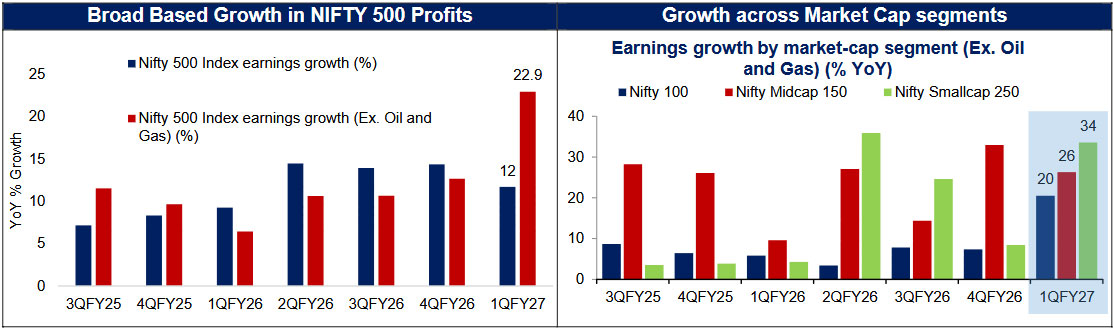
- Nifty 500 companies grew net profit 12% YoY (Year on Year) in Q1FY27 on revenue growth of 19%; excluding oil and gas, profit growth was 23%.
- Excluding oil and gas, growth was broad across market caps, with large caps at 20% YoY, mid caps at 26% YoY and small caps at 34% YoY.
- Growth was well distributed, with 18 out of 29 sectors delivering double-digit YoY profit growth and only 4 sectors declining.
Q1FY27 corporate earnings closed on a broad note, with Nifty 500 companies posting 12% YoY profit growth on revenue growth of 19%. Growth was led by metals and mining (78% YoY) and gas utilities (54% YoY). Excluding oil and gas, profit growth for Nifty 500 was 23%.
Broad-Based Earnings Growth
Earnings growth was broad-based, with 18 sectors out of 29 reporting double-digit YoY growth, 7 single-digit and 4 declining. Financials, the largest profit pool in the index, contributed across the board: banks 24% YoY, insurance 26% YoY and capital markets 25 YoY%. Oil and Gas was the one large drag on the headline growth numbers. Sharp rise in Crude Oil price compressed the margins of state-run retailers.
Excluding Oil and Gas, small caps grew 34% YoY, Mid Cap 26% YoY and large caps 21% YoY. Owing to healthy showing of Small and Mid-Caps over the past few quarters, the large-cap share of Nifty 500 profits has eased to 73% from 78% in Q1FY23, with the small-cap share rising to 10% from 8%.
On the margin front, aggregate EBITDA (Earnings before interest, tax, depreciation, amortisation) margin outside financials contracted 275 bps YoY to 17.5%, with raw material costs rising to 56% of sales from 51%, owing to spike in commodity prices. Excluding oil and gas though, margin was broadly stable.
Sectoral Snapshot
- Banks: Profit growth was driven by lower credit costs and stable asset quality, with slippages under control. Net interest margins narrowed as lending yields repriced faster than deposit costs following the earlier rate cuts. With the rate cut cycle now behind, margins could be supported going forward.
- Metals & Mining: Among the largest gains in the index. Base metal prices spiked through the quarter against the West Asia conflict backdrop, and realisations rose faster than input costs, so the wider spread dropped through to profit.
- Oil & Gas: It was the quarter's one large drag. Crude spiked after the West Asia escalation; upstream producers gained on higher realisations while state-run fuel retailers absorbed the shock through depressed marketing margins. Gas utilities, in contrast, had a strong quarter.
- Information Technology: A steady quarter on reported numbers, though much of the top line reflects translation at a record-low currency. Underlying constant-currency growth was softer, with pricing pressure in managed services.
- Automobiles & Components: Volumes were strong across two-wheelers, passenger vehicles and commercial vehicles, aided by GST rate cuts. Demand was not the constraint; raw material inflation and adverse currency were, while price increases recovered a part of them.
- Capital Goods: Execution stayed strong but profitability did not keep pace, as input costs weighed. Order inflows were healthy though.
- Pharmaceuticals: Better performance from domestic pharma. Margins held up with raw material inflation getting offset by gains from currency depreciation. US Generics was a mixed bag. Hospital occupancy remained stable.
- Consumer Staples: Increase in volumes and price drove top line growth, aided by GST/income tax cuts and improved affordability. Margins narrowed as crude and palm oil-linked input costs rose, with calibrated price increases recovering a part of the impact.
- Construction Materials: Volumes grew well and realisations improved, while fuel and power costs rose sharply. The two roughly offset, leaving margins broadly unchanged.
Conclusion
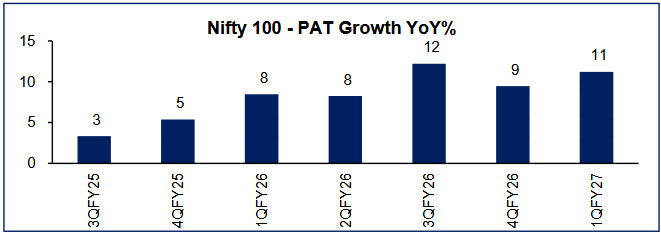
After relatively sluggish growth in last couple of years, corporate profitability has regained momentum, supported by broad-based performance and improving operating metrics. With valuations too having moderated from expensive levels, long-term view on equity market remains constructive.
Sources: ^Kotak Institutional Equities, Capitaline, Bloomberg, and other publicly available information.
Disclaimer: Views expressed herein are based on information available in publicly accessible media, involve known and unknown risks and uncertainties that could cause actual results, performance, or events to differ materially from those expressed or implied herein. The information herein is for general purposes only. Stocks/Sectors/Views referred are illustrative and should not be construed as an investment advice or a research report or a recommendation by HDFC Mutual Fund (“the Fund”) / HDFC Asset Management Company Limited (HDFC AMC) to buy or sell the stock or any other security. HDFC AMC is not indicating or guaranteeing returns on any investments. Past performance may or may not be sustained in the future and is not a guarantee of any future returns. The recipient(s), before taking any decision, should make their own investigation and seek appropriate professional advice.
MUTUAL FUND INVESTMENTS ARE SUBJECT TO MARKET RISKS, READ ALL SCHEME RELATED DOCUMENTS CAREFULLY.
Stay ahead with our insights
Did you find this interesting?
Your opinion matters - share your thoughts and help us improve.