- Entering text into the form field will trigger a list of options
Trending Searches
- Invest / Login
RBI’s October FX Measures Help Stabilize the Rupee Amid Global USD Pressure

Last Updated On: 19 Oct 2026
5 min read
What’s the Point?
- RBI introduced targeted FX measures on October 10—including tighter derivatives norms and direct FX provisioning for key importers—to curb speculative pressure and reinforce rupee stability.
- These steps come at a time when USD strength, high crude prices and elevated US yields have increased external stress, yet the rupee has held up comparatively better versus global peers.
- With policy support and a strong reserve buffer, excess short-term volatility has moderated, improving investor confidence despite a still-uncertain global backdrop.
A broad-based rise in the US dollar spurred the RBI into action
The US Dollar strengthened across a wide range of currencies from the end of August 2026 till October 09, 2026, with DXY (USD Index) up 2.80% over this period. A rate hike by the US Federal Reserve with the potential for more hikes to follow and crude oil prices above $100/bbl have kept the dollar strong. While the rupee did slip against the dollar over this period, the fall was of a smaller magnitude than several other currencies (see chart below). Nevertheless, the Reserve Bank of India (RBI) took decisive steps to curb speculation and stabilize the rupee.
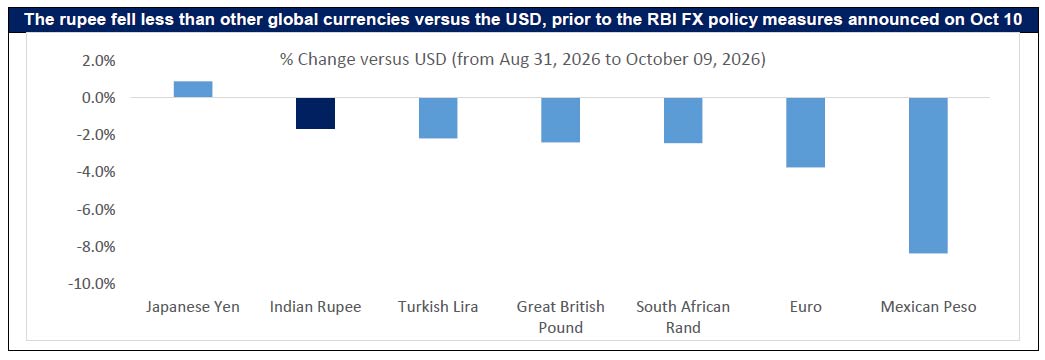
Source: Bloomberg, internal calculations
The RBI’s FX measures announced in October 2026 seek to curb dollar demand and speculation
With a strong reserve buffer in place, and after raising the repo rate by 25 bps to 5.50% at the October policy meeting, the RBI announced FX measures on October 10:
- Special dollar window for public sector oil marketing companies: The RBI will meet the daily dollar requirement of Indian Oil, HPCL and BPCL directly from October 12 until further notice. As some of the largest, most regular dollar buyers, their demand will no longer impact the open market till this measure remains in place.
- Restrictions on rebooking of cancelled foreign exchange derivative contracts: Cancelled rupee derivative trades can no longer be rebooked. However, rollover of foreign exchange derivative contracts on maturity shall continue to be permitted, subject to compliance with the extant regulatory provisions.
- Reduction in the threshold for undertaking foreign exchange derivative transactions without establishing underlying exposure: The existing threshold of USD 100 million equivalent for undertaking foreign exchange derivative transactions to hedge contracted exposures without establishing the existence of the underlying exposure has been reduced to USD 5 million equivalent, across all Authorised Dealers.
- Additional documentation for verification of underlying exposures: Authorised Dealers will be required to obtain and retain an undertaking from users entering into foreign exchange derivative contracts involving INR to hedge contracted exposures, confirming that the same underlying exposure has not been hedged with any other Authorised Dealer.
- Introduction of Foreign Exchange Risk Reserve (FERR): In respect of all rupee derivatives that are for notional value exceeding $2 million equivalent, Authorised Dealers shall be required to maintain with the Reserve Bank an FERR in cash, equal to 20 per cent of the INR equivalent of the notional amount of each transaction. This FERR shall be applicable to rupee derivatives undertaken to hedge current account exposures where the user purchases foreign currency against the INR.
In addition, on October 13, the RBI Governor said the central bank would consider further measures to curb speculative trading in the foreign exchange market if required.
The rupee has reacted positively to the announcement of the October measures
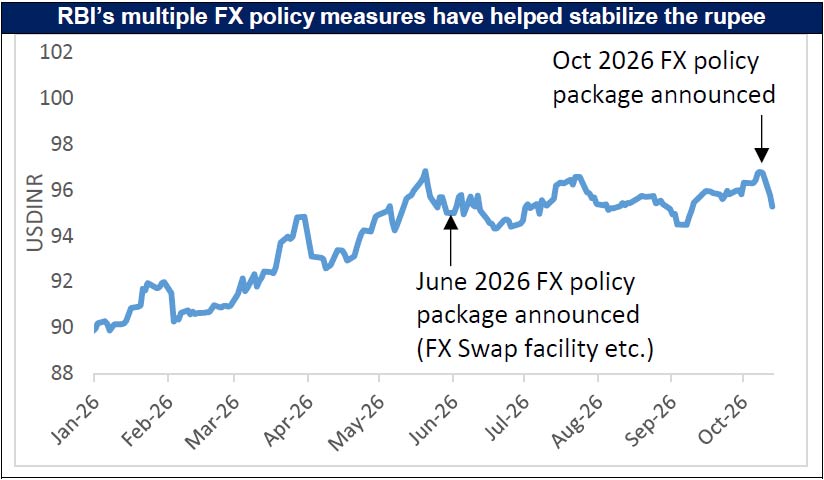
Since the announcement of the measures on October 10, the rupee has strengthened ~1.8% as of October 16. This is noteworthy since the DXY (USD Index) fell ~0.4% over the same period (Oct 9-Oct 16, 2026). The October measures follow from the successful package of FX measures announced by the RBI in June 2026. Cumulative inflows under the RBIs Forex Swap facility reached $143.6 billion by September 18, 2026 — $132.98 bn of Foreign Currency Non- Resident Bank [FCNR(B)] deposits (as of August 31, 2026), $5.32 bn of overseas foreign currency borrowings (OFCBs) and $5.3 bn of external commercial borrowings (ECBs). This FCNR(B) collection is almost ~5x the amount raised under the RBI's 2013 FCNR(B) swap scheme, which had raised ~$26 bn.
Amid FCNR (B)-driven liquidity surplus and yield adjustments, investors may consider selectively adding bond funds with high-quality corporate & long-duration bond strategies, and hybrid strategies with similar debt components
Robust collections under the FCNR(B) scheme have helped create a surplus in banking system liquidity. To absorb some of this liquidity, the RBI announced an OMO sale of ₹25,000 crore of G-Secs and raised the minimum daily cash reserve ratio (CRR) maintenance requirement for banks to 99 per cent from 90 per cent of the prescribed requirement, effective October 16. Since the August 2026 RBI policy meeting, the Indian 10-year benchmark yield has already risen by approximately 50 bps, effectively pricing in a significant portion of RBI’s tightening as well as higher US yields. With the spread between the 1-year OIS and the 10-year G sec now near the long-term average of ~100 bps, a substantial amount of negative information is already reflected in valuations. Accordingly, we do not expect sustained sell-off from the current levels and remain constructive from a medium to long term perspective. Our view is subject to two key risks: crude oil prices remaining elevated for an extended period and US sovereign yields rising further from current levels.
In view of the above and given the substantial liquidity influx driven by FCNR(B) flows is likely to support selective segments, particularly corporate bonds. Investors may consider allocating to high-quality corporate bonds focused funds with the duration of 2- to 4-year segment from a medium-term perspective. Further, given the elevated absolute yield levels at the longer end of the G-sec curve, one may also consider a staggered increase in exposure to longduration funds in line with individual risk appetite.
Conclusion
India’s currency environment remains challenging, shaped by persistent US dollar strength, elevated crude prices and global rate volatility. Against this backdrop, the RBI’s October 10 actions—tightening derivative market norms, discouraging speculative positions, and providing targeted FX liquidity—have helped stabilise the rupee and reduce excess volatility. These measures combined with India’s sizeable reserve cushion, allow the rupee to navigate external pressures with greater resilience. While global risks remain, the policy response has meaningfully strengthened near-term stability, ensuring India’s currency remains better anchored through this phase of heightened global uncertainty.
Source: RBI, Bloomberg, PIB, publicly available information
Disclaimer: Views expressed herein are based on information available in publicly accessible media, involve known and unknown risks and uncertainties that could cause actual results, performance, or events to differ materially from those expressed or implied herein. The information herein is for general purposes only. Stocks/Sectors/Views referred are illustrative and should not be construed as an investment advice or a research report or a recommendation by HDFC Mutual Fund (“the Fund”) / HDFC Asset Management Company Limited (HDFC AMC) to buy or sell the stock or any other security. HDFC AMC is not indicating or guaranteeing returns on any investments. Past performance may or may not be sustained in the future and is not a guarantee of any future returns. The recipient(s), before taking any decision, should make their own investigation and seek appropriate professional advice.
MUTUAL FUND INVESTMENTS ARE SUBJECT TO MARKET RISKS, READ ALL SCHEME RELATED DOCUMENTS CAREFULLY.
Stay ahead with our insights
Did you find this interesting?
Your opinion matters - share your thoughts and help us improve.