
- Entering text into the form field will trigger a list of options
Trending Searches
- Invest / Login
Data Centres and India’s Footing in the AI Race – 2 GW Today, 10 GW by 2031!

Last Updated On: 22 Sep 2026
5 min read
What’s the Point?
- The Government of Maharashtra has announced a 300‑acre Artificial Intelligence (AI) Innovation City with a US$11 billion commitment from Tata Group, adding significant capacity across AI data centres, high‑performance computing and semiconductor activity.
- This is part of a broader national expansion. India’s colocation capacity has increased nearly fivefold since 2019 to about 2 GW and is projected to reach close to 10 GW by 2031, supported by US$45 billion for facilities and US$90 billion for servers.
- Growth is spread across major hubs including Chennai, Hyderabad, Mumbai and other emerging clusters, with cloud providers driving around 60% of demand and pre‑leasing a large share of upcoming capacity. This signals to a committed rather than speculative demand.
India’s Current Standing
Data‑centre utilisation has climbed to roughly 95-97%, bringing vacancy down to 2.8% in H12026 – a sharp decline from 13% in H1 2021. Capacity is heavily clustered in Mumbai and Chennai, with Mumbai projected to take 35% of new additions to 2029. While commissioning is still pending for many projects, the operator landscape has expanded beyond traditional telecom players, with numerous entrants announcing facilities of different sizes.
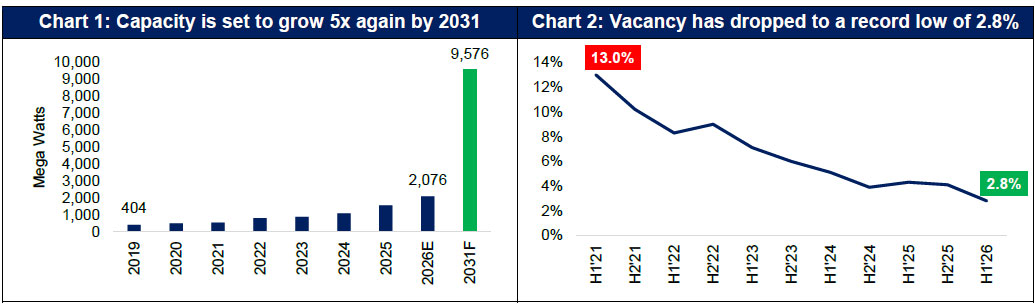
Source: Colliers, Jefferies Estimates, F: Forecast. Chart 2 - Jones Lang LaSalle Incorporated [JLL] (August 2026) (colocation vacancy, %).
Why is the Opportunity real?
The following 2 points signal to India having an economic advantage: (a) Cheaper Industrial Power Costs: ~US$123 per Mega Watt-hour (MWh) against ~US$148 MWh in the United States (US) and US$265 MWh in Singapore, and (2) Cheaper Data Centre Construction in Mumbai: ~US$7 million per MW against ~US$15 million per MW in Tokyo and Singapore.
These advantages have been reinforced by the Indian Government’s policy providing a tax holiday till Tax Year 2046- 47 for notified foreign cloud providers using Indian facilities notified by Ministry of Electronics and Information Technology of India (MeitY). Capital is already flowing in at scale, with the Press Information Bureau reporting that projects worth US$70 billion are currently underway, alongside an additional US$90 billion in announced investment.
What are the Headwinds?
- Imported equipment dominates spend: India does not produce the servers and AI processors that make up US$90 billion of the US$135 billion capex to 2031. This leaves the domestic value in land, construction, power and cooling only to the remaining US$45 billion. The current semiconductor schemes aim to narrow this gap.
- Advanced AI chips are still sourced abroad: India’s US$20 billion semiconductor pipeline targets mature chips and offshore assembly. However, for the advanced AI‑class processors, supply is dependent on imports and foreign export rules.
- Timelines hinge on state power utilities: Power systems account for ~35% of build costs, with Mumbai and Hyderabad taking 59% of planned capacity. Despite approvals, the progress depends on how quickly states deliver grid connections.
- Global pre‑leasing limits domestic access: Cloud providers pre‑booked 82% of H1 2026 leasing, thereby pushing vacancy to 2.8%. This is restricting the space for Indian firms and potentially raising rents, thereby delaying cheaper compute for domestic users.
What does the Capacity enable?
India’s core strength in IT lies in its deep talent pool, representing roughly 20% of the global semiconductor design workforce and supporting IT‑services exports exceeding US$220 billion (Union Budget 2026‑27). Global firms are building on that base, adding 111 new capability centres by August 2026 – more than in all of 2025 – led by Hyderabad, thereby indicating resilient demand. However, the constraint that remains is affordable compute. Affordable compute could widen the opportunity from hosting capacity to building on it, through Indian-language and domain-specific models, Enterprise AI delivered from India, and research computing.
In this respect, the Innovation City would be key at pairing AI data centres with computing, semiconductors and global capability centres in a single cluster. In addition to that, the data centre facility spend deepens capability in transmission equipment, cooling and construction and the Central Electricity Authority projects non-fossil sources at about 70% of installed capacity by 2035-36.
Conclusion
Data centres give India the physical base for its own AI capability. This base is expanding quickly, with capacity projected to reach about 10 GW by 2031 and US$70 billion of investment already underway. A tax holiday running to 2047, also gives cloud providers higher degree of certainty, based on which they can plan their investment in India. As domestic compute becomes more accessible, India is well placed to convert its engineering talent and services strength into AI built at home, which could make data centres a foundational element of India’s Amritkaal ambitions.
Sources: Jefferies, JLL, Central Electricity Authority, PIB, Ministry of Finance, MeitY, Government of Maharashtra announcements, and other publicly available information.
About Tuesday’s Talking Point (TTP): TTP is an effort by HDFC AMC to guide key conversations in the Indian financial markets and investing ecosystem. We aspire to do this by providing relevant facts, along with our perspective on the issue at hand. Please provide your feedback at this link: https://forms.office.com/r/Cr8JNjMGWk
Disclaimer: Views expressed herein are based on information available in publicly accessible media, involve known and unknown risks and uncertainties that could cause actual results, performance, or events to differ materially from those expressed or implied herein. The information herein is for general purposes only. Stocks/Sectors/Views referred are illustrative and should not be construed as an investment advice or a research report or a recommendation by HDFC Mutual Fund (“the Fund”) / HDFC Asset Management Company Limited (HDFC AMC) to buy or sell the stock or any other security. HDFC AMC is not indicating or guaranteeing returns on any investments. Past performance may or may not be sustained in the future and is not a guarantee of any future returns. The recipient(s), before taking any decision, should make their own investigation and seek appropriate professional advice.
MUTUAL FUND INVESTMENTS ARE SUBJECT TO MARKET RISKS, READ ALL SCHEME RELATED DOCUMENTS CAREFULLY.
Stay ahead with our insights
Did you find this interesting?
Your opinion matters - share your thoughts and help us improve.