
- Entering text into the form field will trigger a list of options
Trending Searches
- Invest / Login
Handling the Heat - India’s Power Grid remains resilient

Last Updated On: 5 May 2026
5 min read
What's the Point?
- India's power grid has undergone a remarkable transformation over the past decade — with the transmission network expanding 71%, installed renewable capacity rising from 76 Gigawatt (GW) in 2014 to 283 GW in 2026, and rural electricity supply nearly doubling. The grid has held firm through record peak demand of 256 GW in April 2026.
- Four structural improvements – a clean energy build-out, a stronger transmission backbone, higher rural supply and smarter grid management – underpin this resilience.
- Scaling up energy storage and improving last mile distribution remain key priorities ahead.
India’s Grid has witnessed Strong Improvements across Several Parameters
India's electricity grid faced immense strain in late April 2026, with peak power demand hitting an all-time high of 256 GW. This was driven by an unusually early heatwave. However, the grid did not buckle, and this resilience is not accidental. It is the result of a decade of sustained investment, policy reform, and institutional capacity-building that has fundamentally changed how India's power system operates.
Source: Ministry of Power, Central Electricity Authority, Press Information Bureau (PIB)
What has actually changed – The Four Big Shifts
1. A Far Stronger Transmission Backbone
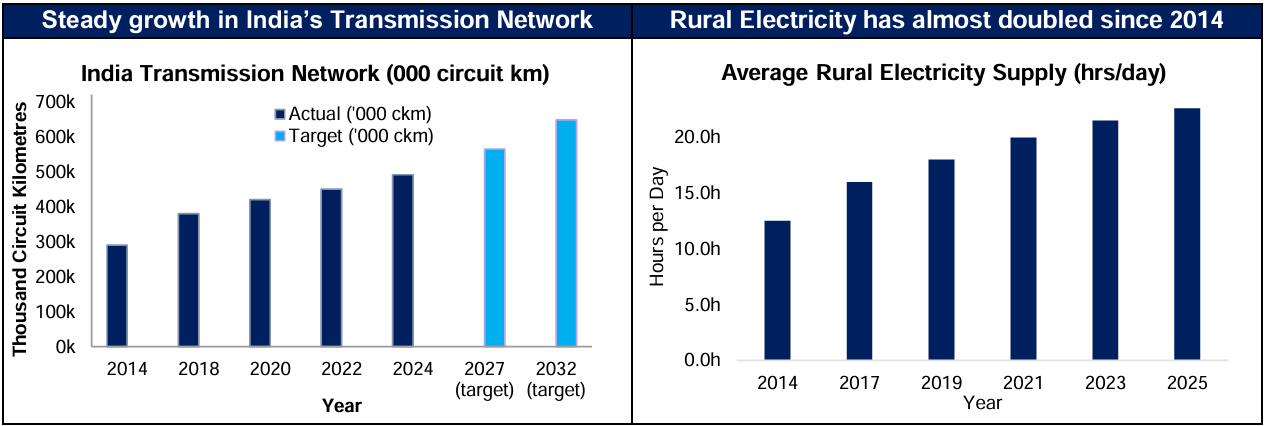
Transmission lines are the ‘highways’ of the grid, that carry electricity between states. More circuit kilometres mean power can flow from surplus regions to deficit ones, increasing overall grid stability. India's high-voltage transmission network has grown 71% since 2014, crossing 5,00,000 circuit kilometres (Jan 2026). Inter-regional transfer capacity — the ability to move power across different parts of the country — stands at 120 GW (Jan 2026), helping realize the vision of “One Nation – One Grid – One Frequency”.
2. A Massive Clean Energy Build-Out
India has 283 GW of non-fossil power capacity (Mar 2026) — solar, wind, hydro & nuclear combined — up from just 76 GW (Mar 2014). That is a near-fourfold increase in just over a decade, making India the world's third-largest solar power producer. Renewables now make up over 50% of total installed capacity,
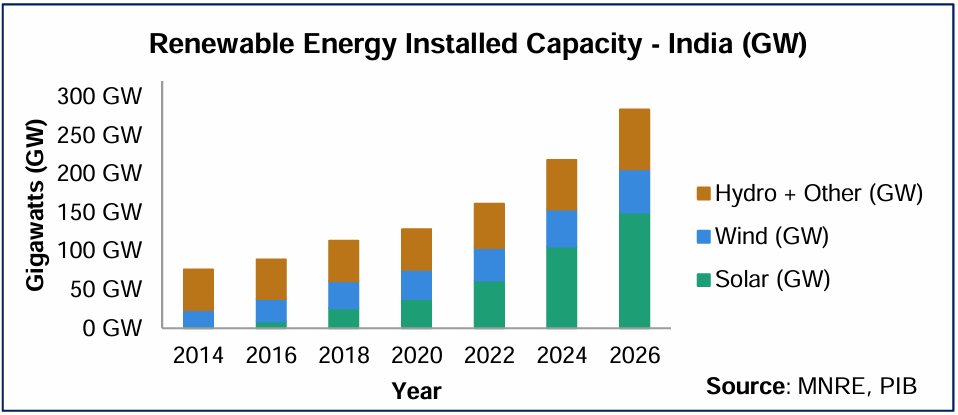
India achieved a milestone by reaching its 2030 Nationally Determined Contribution (NDC) target five years ahead of schedule. Solar energy has led this growth, increasing from just 3 GW in March 2014 to 150 GW in March 2026. During the current heatwave, solar generation has significantly contributed during daylight hours, helping reduce pressure on the grid, especially during peak afternoon demand.
3. Improvement in Rural Electricity Supply
Average rural electricity supply has risen from 12.5 hours per day in 2014 to 22.6 hours in FY2025, providing nearly round-the-clock power for rural communities.
4. Smarter real-time grid management
India has deployed Regional Energy Management Centres (REMCs) to forecast and monitor renewable output in real time. These centres help track where power is being generated and route it efficiently to where it is needed.
Areas for Improvement across Storage Capacity, Transmission and Distribution remain
Storage remains an important area for improvement. India currently has under 5 GW of battery storage, meaning solar power generated during the day cannot yet be reliably used during the evening peak. The government is actively addressing this, with 47 GW of battery energy storage systems (BESS) and 30 GW of pumped storage plants mandated under the National Electricity Plan (Transmission) through 2032. Additionally, with a planned addition of 190,000 circuit kilometres of transmission lines and 1,270 Gigavolt-amperes (GVA) of transformation capacity over the next decade, the plan presents an investment opportunity of over Rs. 9 lakh crores in the transmission sector. Finally, on the distribution side, the Revamped Distribution Sector Scheme (RDSS) has been launched by the Government with the objective of upgrading distribution networks and increasing the operational efficiency and financial viability of the Distribution Utilities.
Outlook and Conclusion
India's grid story is one of strong and measurable progress, having come a long way from large-scale blackouts in 2012. With India’s share of renewable energy set to further increase, planned capacity ramp-ups across storage capacity and transmission, and ongoing reforms to improve distribution, India is building not just a bigger grid — but a fundamentally more reliable one.
Source: PIB, India Brand Equity Foundation (IBEF), publicly available sources
Disclaimer: Views expressed herein are based on information available in publicly accessible media, involve known and unknown risks and uncertainties that could cause actual results, performance, or events to differ materially from those expressed or implied herein. The information herein is for general purposes only. Stocks/Sectors/Views referred are illustrative and should not be construed as an investment advice or a research report or a recommendation by HDFC Mutual Fund (“the Fund”) / HDFC Asset Management Company Limited (HDFC AMC) to buy or sell the stock or any other security. HDFC AMC is not indicating or guaranteeing returns on any investments. Past performance may or may not be sustained in the future and is not a guarantee of any future returns. The recipient(s), before taking any decision, should make their own investigation and seek appropriate professional advice.
MUTUAL FUND INVESTMENTS ARE SUBJECT TO MARKET RISKS, READ ALL SCHEME RELATED DOCUMENTS CAREFULLY.
Stay ahead with our insights
Did you find this interesting?
Your opinion matters - share your thoughts and help us improve.