
- Entering text into the form field will trigger a list of options
Trending Searches
- Invest / Login
Gold’s Wealth Effect : Boost to Household Confidence and Liquidity

Last Updated On: 29 Jan 2026
5 min read
What’s the Point?
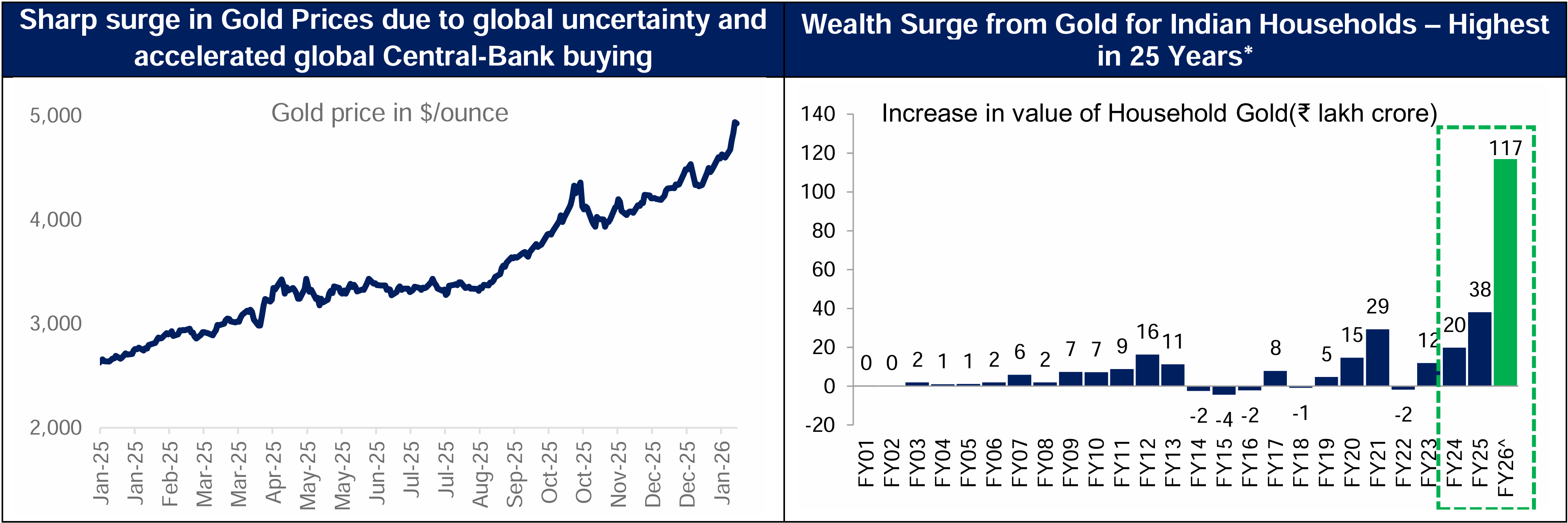
Gold-driven wealth effect: With Gold prices rising sharply, the valuation of household Gold has witnessed an unprecedented increase of more than ₹100 trillion in FY26^, which is the largest wealth increase in over 25 years.
Wealth effect supports consumption: Elevated Gold prices continue to reinforce household balance sheets, enhancing perceived financial security, thereby supporting both, discretionary and essential consumption.
Higher collateral unlocks liquidity: As prices rise, the collateral value of existing Gold holdings automatically increases, enabling higher eligible loan amounts, improved loan-to-value ratios and easier access to short-term credit, thereby strengthening household liquidity and financial flexibility.
Since beginning of 2025, Gold prices have surged by ~90% (Absolute - Upto 22-Jan-26), driven by global structural forces, accelerated central-bank buying and ongoing de-dollarisation. For India, which holds one of the world’s largest household Gold, this move has significant domestic implications. Gold in India is not just an investment asset; it is a culturally embedded store of value that sits at the core of household balance sheets. As prices rise, household net worth, liquidity buffers and borrowing capacity expand automatically turning a global commodity trend into a meaningful domestic macro driver.
Wealth Effect of Gold price rise on Indian Households
Indian households collectively own more than 25,000 tonnes of Gold*, making it a dominant store of value. With Gold prices rising sharply, the valuation of household Gold has witnessed an unprecedented ₹117 trillion increase in FY26^, the largest wealth increase in over 25 years. In fact, every ₹1,000/gram increase in Gold prices adds nearly ₹1 lakh to average household wealth through mark-to-market gains. This passive wealth effect, independent of buying or selling, has far reaching impact on Indian households.
Implications for Indian Households
1) Consumption boost via higher consumer confidence
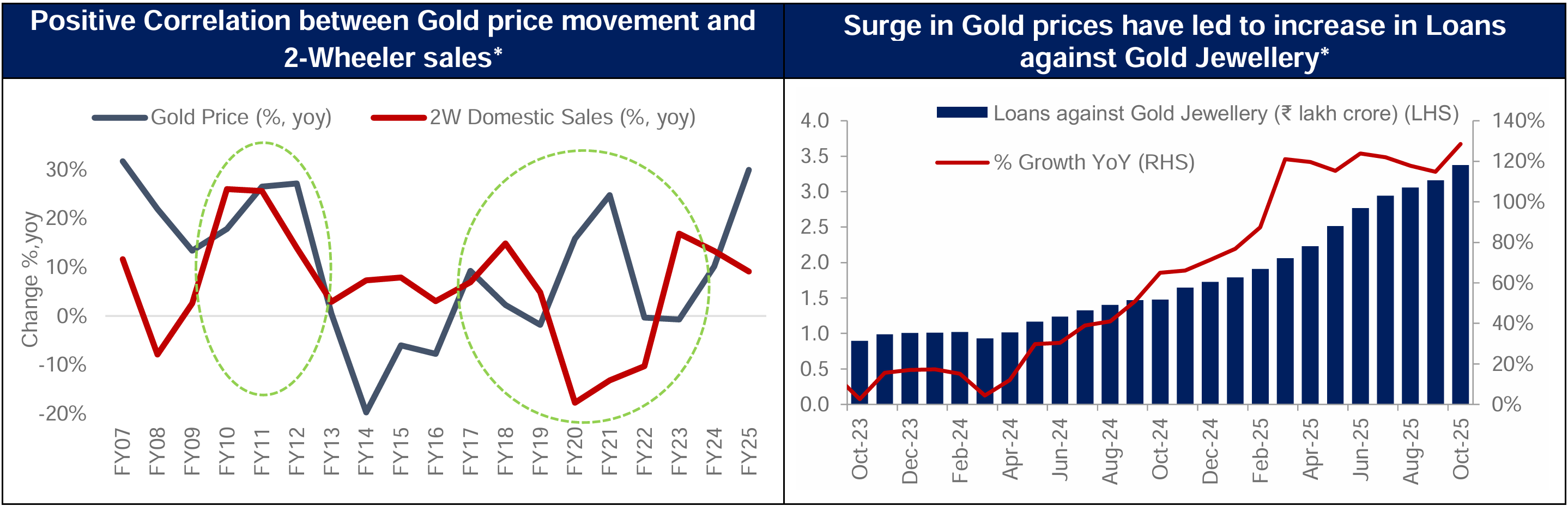
Rising Gold valuations enhance the perceived financial security of households, especially in rural and semi-urban India, which together account for more than half of India’s household gold reserves. As Gold prices rise, household balance sheets strengthen and precautionary saving needs decline, creating room for both discretionary and non discretionary spending. Historically, periods of rising gold prices have shown a positive correlation with two-wheeler sales and revenues of consumer-durables companies, suggesting that households become more willing to spend when their Gold wealth appreciates. Consequently, Gold price upswings transmit into the economy through confidence-driven consumption even without liquidation of Gold holdings.
2) Liquidity unlocked through higher gold-backed borrowing
Households in India typically view Gold as a long-term store of value and therefore rarely sell it outright. Instead, rising Gold prices are increasingly monetised through pledging, allowing households to unlock liquidity without relinquishing ownership. As prices rise, the collateral value of existing Gold holdings automatically increases, enabling higher eligible loan amounts, improved loan-to-value ratios and easier access to short-term credit. Reflecting this dynamic, outstanding Gold loans have nearly tripled since Apr’24 (to around ₹3 trillion)* with an increase in price of Gold. This mechanism effectively converts passive balance-sheet gains into usable liquidity, strengthening household cash flows and financial flexibility.
Conclusion: From a consumption and holistic economic standpoint, rising Gold prices have acted as a quiet but powerful stabiliser for India’s household sector. Mark-to-market gains have strengthened balance sheets, improved perceived financial security and unlocked liquidity without asset liquidation. This has supported discretionary and essential spending while easing credit constraints via gold-backed borrowing. Amid global headwinds, this balance sheet-to-spending transmission has anchored domestic demand. That said, with Gold prices having surged over the past couple of years amid heightened geopolitical uncertainty and accelerated central-bank buying, it will be important to watch how prices react once global conditions normalise and risk-on sentiment returns.
Sources: CMIE, *Avendus Spark, Bloomberg and other publicly available information ^ Upto Dec’25,
Disclaimer: Views expressed herein are based on information available in publicly accessible media, involve known and unknown risks and uncertainties that could cause actual results, performance, or events to differ materially from those expressed or implied herein. The information herein is for general purposes only. Stocks/Sectors/Views referred are illustrative and should not be construed as an investment advice or a research report or a recommendation by HDFC Mutual Fund (“the Fund”) / HDFC Asset Management Company Limited (HDFC AMC) to buy or sell the stock or any other security. The Fund/ HDFC AMC is not indicating or guaranteeing returns on any investments. Past performance may or may not be sustained in the future and is not a guarantee of any future returns. The recipient(s), before taking any decision, should make their own investigation and seek appropriate professional advice.
MUTUAL FUND INVESTMENTS ARE SUBJECT TO MARKET RISKS, READ ALL SCHEME RELATED DOCUMENTS CAREFULLY.
Stay ahead with our insights
Did you find this interesting?
Your opinion matters - share your thoughts and help us improve.