Whats the Point?
- Gold’s recent correction has largely been driven by rising global yields and a stronger US dollar, as higher oil prices led markets to scale back expectations of rate cuts globally.
- Despite these short-term headwinds, gold continues to play an important role in asset allocation via portfolio diversification, having historically performed well during periods of equity market stress, including this latest episode of market volatility.
- Investors may benefit from maintaining their allocation to gold by using systematic approaches like SIPs/STPs during periods of price weakness to enhance return potential over time.
Markets pricing out rate cuts by global central banks contributed to gold’s correction in March 2026
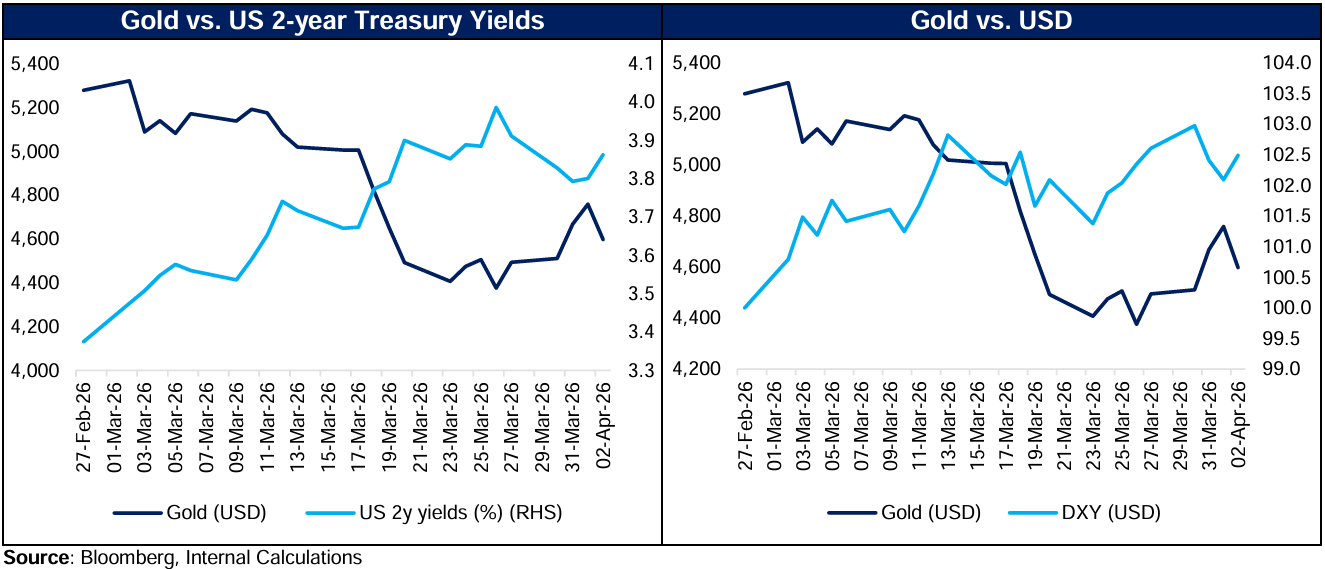
Gold’s steep correction in March 2026 during the ongoing West Asia conflict has been driven mainly by the spike in oil prices and associated inflation risks led to reduced expectations of rate cuts by global central banks. The resulting higher yields and strengthening USD caused investors to shift away from gold in the short-term. Second, gold’s strong performance over recent months and the last 1 year, made it vulnerable to profit taking. Rising yields and the stronger USD proved to be a catalyst for profit taking, leading to a -11.6% fall in gold price in USD terms since the conflict broke out (data from Feb 27, 2026 to Mar 31, 2026).
US Treasury Yields and USD have become highly negatively correlated with gold since the conflict started
Purchases of gold by Central Banks – a tailwind for prices since 2022 – face short-term uncertainty
While still elevated, central bank (CB) purchases of gold slowed in CY2025 compared to the prior 3 years. CB purchases totalled 863 metric tonnes in 2025, down from the 1,000+ metric tonnes per year run rate from CY2022 24. In the short-term, the outlook for CB gold purchases remains uncertain for both oil importers and exporters. With the USD strengthening, CBs of energy importing countries may have to use their FX Reserves to defend falling currencies, which leaves less room to make additional gold purchases until macro stability returns. For example, Turkey, a large energy importer, has seen a significant fall in its gold reserves since the conflict broke out.
On the other hand, higher energy prices generally lead to reserve growth for energy exporting countries as they earn higher revenue. They could potentially deploy such surpluses into additional gold purchases. However, this time, several Gulf countries’ exports have been impacted by the impasse in the Strait of Hormuz, and they may need to draw down on their reserves to plug potential budget shortfalls. Thus, continued uncertainty around the conflict could affect CB gold purchases over the short-term.
Despite short-term volatility, Gold’s role in Asset Allocation remains undiminished
Gold is a critical portfolio diversifier as it may help balance portfolios against the volatility of other asset classes. In particular, gold has outperformed equities during historical episodes of market stress. In the most recent correction, the Nifty 50 TRI is down -15.1% while Gold (INR)* is up 8.4% (Data from Jan 2, 2026 to Mar 30, 2026). Other historical examples are provided alongside.
Gold has historically cushioned equity market volatility
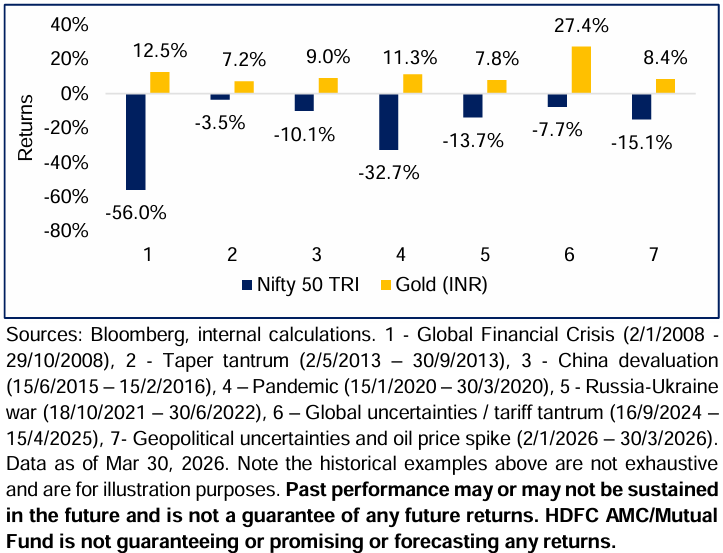
Thus, investors should look through the short term volatility and instead to maintain their desired long-term allocation to Gold in line with their risk tolerance and investment objectives.
Outlook and Conclusion
Gold’s correction in March 2026 can broadly be attributed to rising yields and stronger USD as the oil price spike led to concerns around global central bank’s reducing their pace of tightening. Similar to other asset classes, the short-term outlook for gold depends on how the conflict unfolds. The speed and degree with which oil supplies and supply chains normalize will determine the inflation outlook and in turn affect the Fed’s interest rate plans. Longer term, however, gold can continue to benefit from increasing concerns around weakening fiscal positions across large global economies, trade frictions and geopolitical tensions remaining high in an increasingly multipolar world.
Investors can consider investing in gold via Systematic Investment Plan (SIP) / Systematic Transfer Plan (STP) over this volatile period and beyond. Maintaining SIP/STPs during correction phases as we are currently experiencing can be particularly beneficial, as investors can accumulate more units at relatively lower prices. Such accumulation of units during price declines improves long-term return potential through cost averaging.
Sources: Bloomberg, NSE Indices Ltd., internal calculations, publicly available information. *Gold (INR) do not include any customs duties, local taxes etc.
Disclaimer: Views expressed herein are based on information available in publicly accessible media, involve known and unknown risks and uncertainties that could cause actual results, performance, or events to differ materially from those expressed or implied herein. The information herein is for general purposes only. Stocks/Sectors/Views referred are illustrative and should not be construed as an investment advice or a research report or a recommendation by HDFC Mutual Fund (“the Fund”) / HDFC Asset Management Company Limited (HDFC AMC) to buy or sell the stock or any other security. HDFC AMC is not indicating or guaranteeing returns on any investments. Past performance may or may not be sustained in the future and is not a guarantee of any future returns. The recipient(s), before taking any decision, should make their own investigation and seek appropriate professional advice.
MUTUAL FUND INVESTMENTS ARE SUBJECT TO MARKET RISKS, READ ALL SCHEME RELATED DOCUMENTS CAREFULLY.