
- Entering text into the form field will trigger a list of options
Trending Searches
- Invest / Login
Weathering the Headwinds: Signs of Underlying Economic Strength

Last Updated On: 20 Aug 2026
5 min read
What’s the Point?
- India’s economy remained firmly supported during the West Asia conflict, with consumption, industrial activity, tax collections and investment indicators continuing to grow, despite elevated commodity prices
- Earlier policy measures—including income tax cuts, GST reforms and RBI rate reductions—relatively helped sustain domestic demand and cushion the economy from external shocks.
- With the conflict ending and commodity prices easing, external pressures have receded, creating a more supportive backdrop for growth.
When conflict escalated between Iran and the United States during March–June 2026, India appeared exposed. With approximately 85% dependence on imported crude oil and substantial reliance on energy flows linked to the Strait of Hormuz, concerns centred on a potential spike in oil prices, supply disruptions and a resulting drag on growth. Consensus expectations were that a sustained energy shock would weaken consumption, industrial activity and business confidence.
The data, however, tell a different story. Growth indicators remained resilient throughout the conflict period. LMV registrations maintained their momentum, rising 28.9% YoY in March 2026, 20.0% in April and 25.1% in May. Two wheeler registrations expanded by 33.6%, 17.2% and 8.3% YoY in March, April and May 2026 respectively. Over the same period, tractor registrations rose by 16.2%, 28.6% and 16.0% YoY respectively.
Several key Indian economic indicators remained resilient through the West Asia conflict (YoY change)
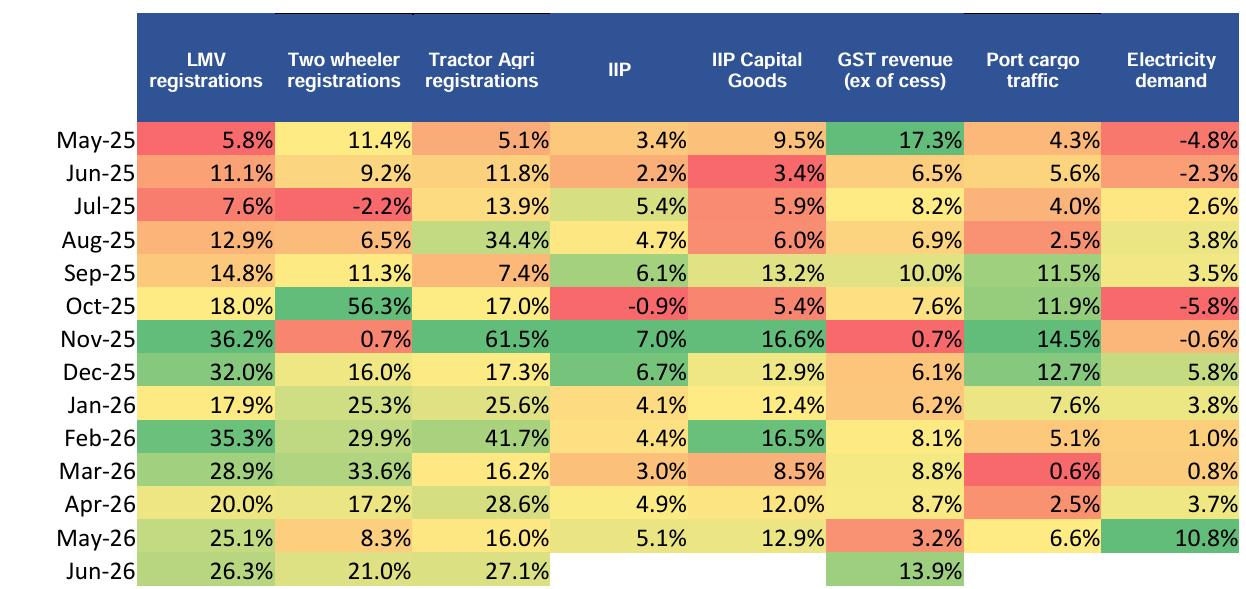
Source: CMIE. LMV = Light Motor Vehicle. IIP = Index of Industrial Production
Fiscal and economic activity indicators remained equally supportive. GST revenue (excluding cess) grew 8.8% YoY in March, 8.7% in April and 3.2% in May 2026. Also noteworthy is that GST collections reached a record ₹2.43 lakh crore in April 2026 despite the ongoing conflict. Electricity demand increased 0.8% in March, 3.7% in April and 10.8% in May. Port cargo traffic expanded 0.6% YoY in March, 2.5% in April and 6.6% in May. Industrial production growth remained positive at 3.0%, 4.9% and 5.1% YoY respectively, while capital goods production—a key proxy for investment demand—grew 8.5%, 12.0% and 12.9% YoY in March, April and May 2026 respectively.
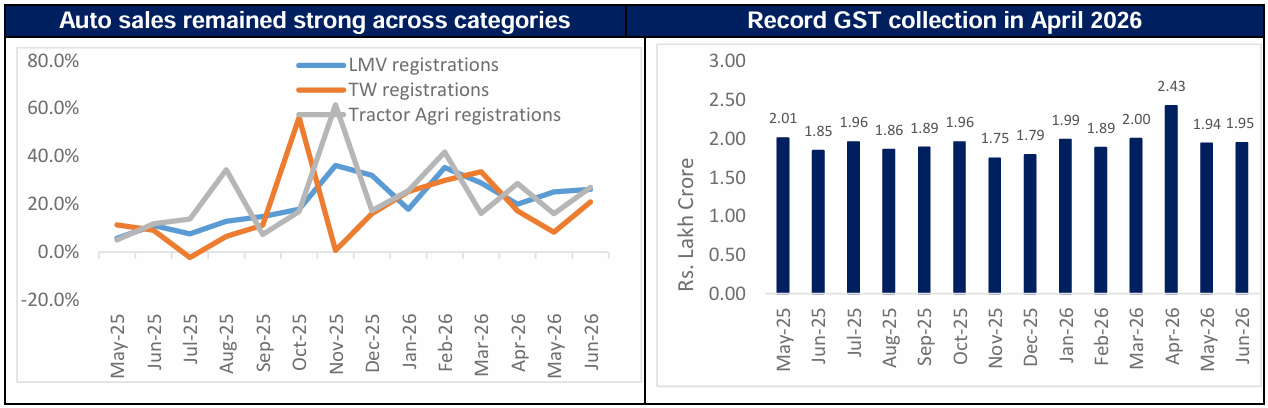
Source: CMIE
Supportive policies implemented earlier played a key role in sustaining this resilience
The resilience of the economy during this testing period was not accidental. The economy benefited from policy support already working through the system, implemented by both the Government and RBI. The 2025 income-tax reductions boosted disposable incomes, GST slab simplification improved efficiency and compliance, while RBI rate cuts during the current easing cycle improved liquidity and financial conditions. These measures relatively helped offset external uncertainty and ensured domestic demand remained the primary growth driver.
Economic data for June point to resilience continuing. With external headwinds receding and the monsoon showing signs of recovery, growth conditions could improve further
LMV, 2-wheeler and tractor registrations rose 26.3%, 21.0% and 27.1% respectively in June 2026. Meanwhile, GST revenue (ex of cess) rose 13.9% YoY for the same period. Additionally, the cumulative rainfall (% departure) over the country as a whole has reduced to -24.1% as of July 5, 2026, an improvement from the approximately -40% departure recorded at the end of June.
Conclusion
The economy remained resilient as per the above data, when oil prices and supply-chain concerns were elevated. Now that the conflict has ended and commodity prices have retraced sharply, the macro backdrop has become considerably more supportive. Lower energy costs improve household purchasing power, support corporate margins and reduce inflation pressures. India's economy appears to have successfully passed a major external stress test and may now be positioned to benefit from the removal of that headwind.
Source: CMIE, IMD, publicly available information
Disclaimer: Views expressed herein are based on information available in publicly accessible media, involve known and unknown risks and uncertainties that could cause actual results, performance, or events to differ materially from those expressed or implied herein. The information herein is for general purposes only. Stocks/Sectors/Views referred are illustrative and should not be construed as an investment advice or a research report or a recommendation by HDFC Mutual Fund (“the Fund”) / HDFC Asset Management Company Limited (HDFC AMC) to buy or sell the stock or any other security. HDFC AMC is not indicating or guaranteeing returns on any investments. Past performance may or may not be sustained in the future and is not a guarantee of any future returns. The recipient(s), before taking any decision, should make their own investigation and seek appropriate professional advice.
MUTUAL FUND INVESTMENTS ARE SUBJECT TO MARKET RISKS, READ ALL SCHEME RELATED DOCUMENTS CAREFULLY.
Stay ahead with our insights
Did you find this interesting?
Your opinion matters - share your thoughts and help us improve.