- Entering text into the form field will trigger a list of options
Trending Searches
- Invest / Login
Market Review - July 2025

Last Updated On: 15 Sep 2025
 Macroeconomic Update
 Equity Market Update
 Debt Market Update
Macroeconomic Update
The month of July saw heightened activity related to trade negotiations with US. While the US signed trade deals with EU, Japan and Indonesia, it slapped reciprocal tariff on several other countries including India. While headline Q2 GDP growth in US was strong, growth was driven by import normalisation while domestic demand growth was muted. Moreover, latest labour data suggests that non-farm job creation was much below expectations with previous two months' data also revised downwards, suggesting weakness in the economy. While Q2 GDP in China was better than expected, the economy continued to face trade related headwinds reflected in weak manufacturing PMI numbers which remained in contraction mode in July. Eurozone showed signs of improvement as new orders stopped falling for the first time in 3 years and business confidence reached its highest level since June 2022. Manufacturing PMI for the region was recorded at 3 years high, though still in contraction zone.
Inflation moved within a narrow range and largely on expected lines across most major economies. Recent inflation prints in the US showed signs of tariff impact as imported goods inflation edged higher. Fed kept rates unchanged in its July meet and has signalled that it will be data dependent. ECB also kept rates unchanged and has signalled a pause hereafter.
High frequency indicators point towards moderating demand: Pace of vehicle registrations except of tractors moderated in July suggesting weak demand momentum. GST collections growth too appears to be in slow lane growing by an average of ~7% in the past two months. However, power demand was back in positive territory after contracting for two consecutive months and both manufacturing and services PMI readings were healthy.
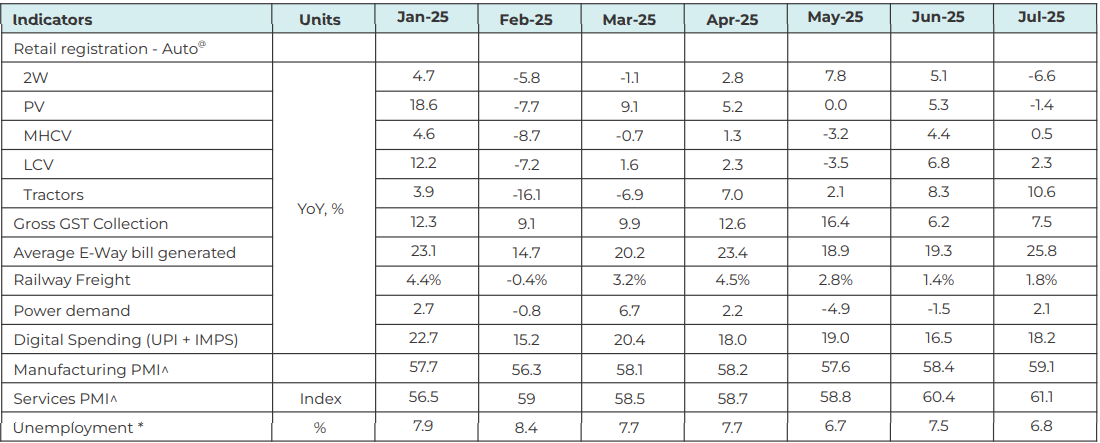
Source: www.gstn.org.in, www.icegate.gov.in, CMIE, PIB, RBI, www.vaahan.parivahan.gov.in, www.posoco.in
^Number >50 reflects expansions and number <50 reflects contraction compared to previous month. @ - figures are preliminary data and are subject to revision.
* based on CMIE survey
Going forward, urban demand is likely to get a boost from income tax relief and easing monetary conditions while rural demand too is likely to remain steady on back of strong rabi output and prospects of above normal monsoon. However, global trade uncertainties may dampen sentiment and could weigh on India's growth prospects.
Government spending picks up while tax growth moderates: Gross tax revenue growth in the first three months of this fiscal has been sluggish driven by contraction in direct tax collections even though indirect tax growth has been decent. Non-tax revenue growth remained buoyant on the back of higher than budgeted RBI dividend transfer. Total expenditure growth in first three months was up 26% driven by healthy growth in both capex and revex. As a result, fiscal deficit at the end of June was 18% of budget estimates compared to 8% during the same period last year.
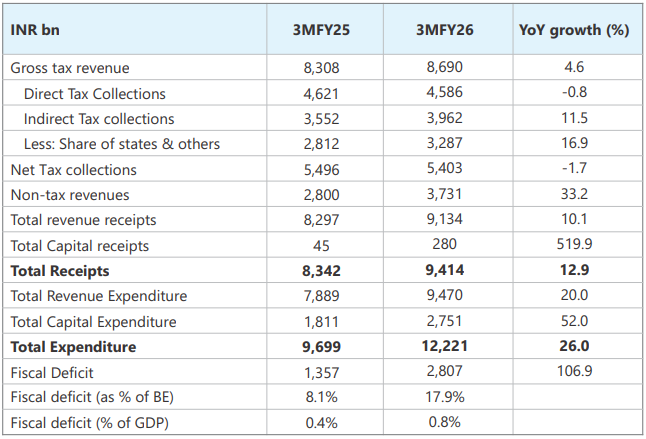
Source: CMIE
Trade deficit narrowed in June: Merchandise trade deficit fell in Jun'25 compared to the previous month led by decline in non-oil, non-gold (NONG) imports.
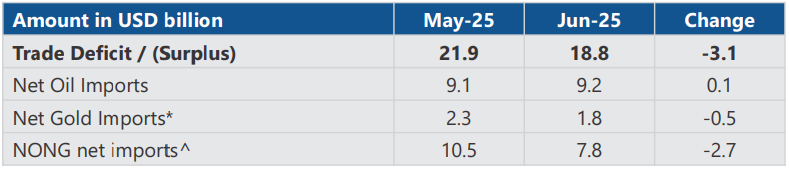
Source: CMIE, Ministry of Commerce; *Net Gold includes gold, silver and pearls precious and semiprecious stones adjusted for gems and jewellery exports. ^NONG refers to Non-Oil NonGold (as defined above) imports/exports
The trade deficit is likely to remain range-bound going forward. Further, healthy growth in services exports is likely to keep current account within manageable range. However, trade disruptions due to tariff related issues can have adverse effect on India's trade dynamics going forward.
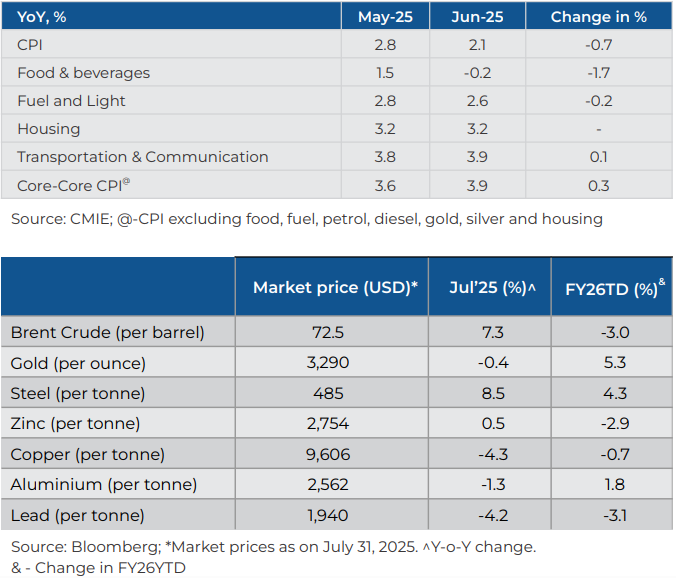
Retail inflation in Jun at 6 years low: India's CPI inflation in June was recorded at its lowest level since Jan'19 driven by further moderation in food prices and favourable base. Core-Core (which excludes food, fuel, petrol, diesel, gold, silver and housing) however inched up by 30bps driven higher services prices.
CPI inflation is likely to remain below 4% in the coming months due to favourable outlook on food inflation and favourable base effect.
Commodity prices: Oil prices increased during the month following US-EU trade deal and concerns around Russian supply. Steel prices rallied in response to Chinese leadership decision to deal with oversupply and deflation.
Summary and Conclusion:
Global growth prospects today face unprecedented uncertainty due to US' tariff policy and risk of geopolitical flare up. US growth is exhibiting early signs of slowdown with softness in labour market now visible in data. This is likely to deteriorate going forward as effects of tariffs and uncertainty weigh on prospects. Domestic demand in China remains subdued and deflationary forces have gathered steam. The global growth prospects hinges on the outcome of US trade policy and in this regard outcome on trade negotiations with different countries remain a key monitorable going forward.
India's growth momentum too is showing signs of a slowdown. Merchandise exports likely to be hit in the wake of higher tariff imposition than other countries. However, going forward urban consumption is likely to get a boost due to income tax relief announced by the Government and monetary easing by the RBI. Rural consumption too is likely to remain steady on the back of prospects of above normal monsoon, falling inflation and higher real rural wage growth. India's external sector also remains comfortable on the back of low current account deficit and adequate forex reserves. Rise in geopolitical tensions and a tariff related uncertainty are key near-term risks.
Looking ahead, the medium-term outlook for India's economy seems optimistic, in our view. This optimism is driven by bi-lateral trade deal with various countries, enhanced infrastructure investments, the potential of pick-up in private sector capex, and the likely boost to private consumption.
Stay ahead with our insights
Did you find this interesting?
Your opinion matters - share your thoughts and help us improve.