- Entering text into the form field will trigger a list of options
Trending Searches
- Invest / Login

Don't Let The Waves Rock Your Long-Term Boat!

Last Updated On: 6 Nov 2026

Markets could rise and fall every day. The investors who reach their goalsare usually the ones who stay on course through the choppy patches.
Over the past several months, Indian equity markets have been through a correction, and portfolios thatlooked healthy a year ago may now be showing losses. It is natural to feel uneasy. But short-term fallsare a normal part of equity investing, and the time in the market matters far more than any single badmonth or year.
In this edition, we look at what volatility is, what the data says about short-term losses, and how a long-term horizon can help investors ride out the waves.

A sea is never perfectly still, and neither is the stock market. How volatile a portfolio looks depends a loton how closely we watch it. The same investment can look worrying over a month and rewarding overa decade.
The period over which an investment is evaluated can significantly influence how itsperformance appears.
The one-month and one-year views capture relatively short periods and show declines. The 15-year viewcovers several market cycles and presents a substantially different picture.
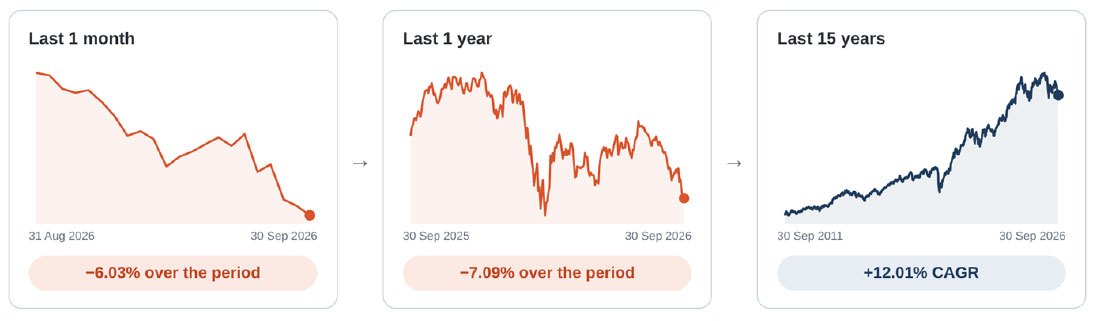
Past performance may or may not be sustained in future and is not a guarantee of any future returns. HDFC AMC / HDFC MF is notguaranteeing or assuring any returns on investments.
Actual returns based on Nifty 50 TRI values as on 30th September 2026, less than 1-year Absolute returns, Greater than or Equal to 1-yearCompound Annualized returns. Source: MFI 360
The longer the investment horizon, the less influence any single year may have on the overallexperience. Looking at every rolling period of Nifty 50 TRI from 30th Sep 2007 till 30th Sep2026, the gap between the best and the worst outcome narrows sharply as the holding periodgets longer.
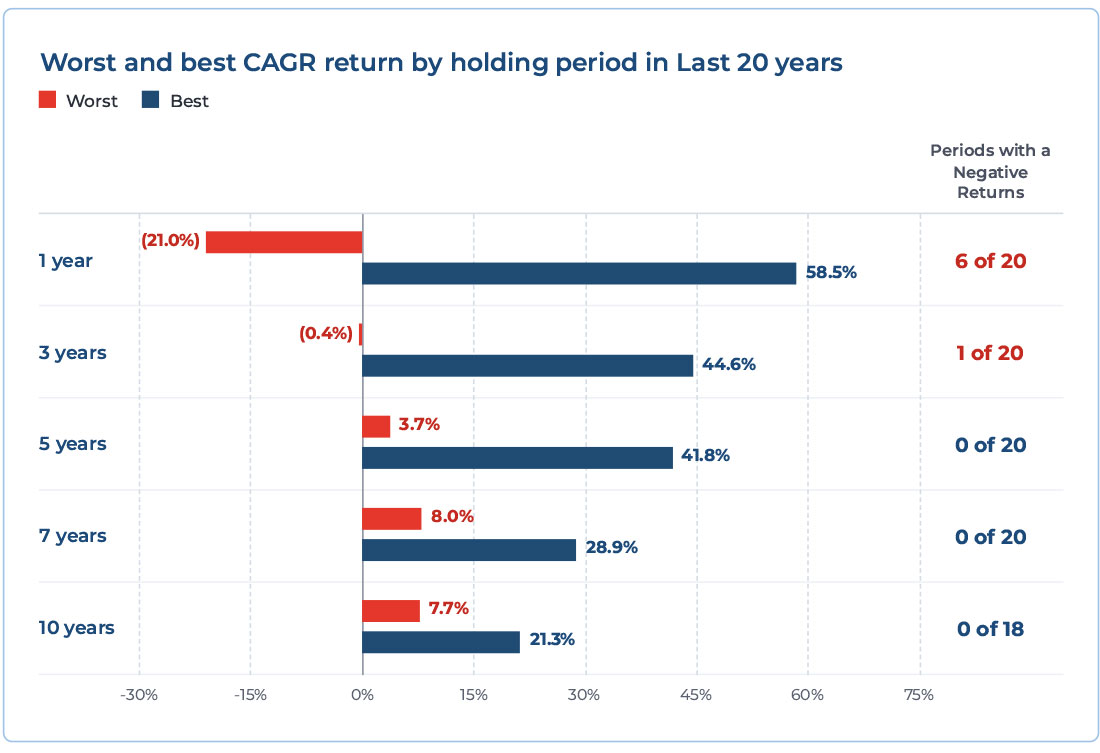
Each bar shows the highest and lowest CAGR return among all the rolling periods from 30th September2007 to 30th September 2026. Example, for a 10-year holding period the instances of negative returnsis zero.
CAGR - Compound Annual Growth Rate
Past performance may or may not be sustained in future and is not a guarantee of any future returns. HDFC AMC / HDFC MF is notguaranteeing or assuring any returns on investments.
Actual returns based on Nifty 50 TRI values as on 30th September 2026, Source: MFI 360.
Systematic Investment Plans (SIPs) are considered to have an impact during volatile markets, asthey enforce disciplined investing regardless of market direction.
SIPs continue purchasing units across varying market conditions – buying more units at lowerprices during downturns. This could lead to improved returns when looked at from a long-term perspective.
Consider a monthly SIP of ₹ 10,000 in HDFC Flexi Cap Fund.
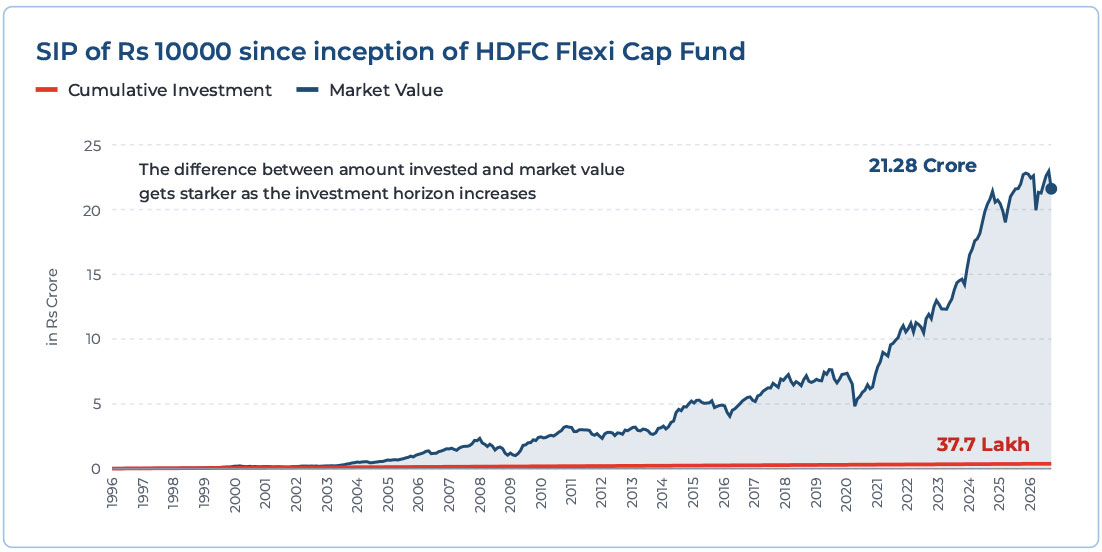
Scheme Inception Date: January 1, 1995. The above NAV’s are of Regular Plan - Growth Option. Past Performance may or may not besustained in future returns and is not a guarantee of any future returns. Data as on September 30, 2026.
HDFC AMC / HDFC MF is not guaranteeing or assuring any returns on investments in this Scheme.
Hybrid funds could help hide volatility and support asset allocation:
Hybrid funds invest across equity and debt, which can help reduce portfolio fluctuations duringvolatile markets while maintaining equity participation over time. For example, funds like HDFC Balanced Advantage Fund dynamically manage equity and debt exposure based on marketconditions, helping investors stay aligned to asset allocation without the need for frequentmanual adjustments.
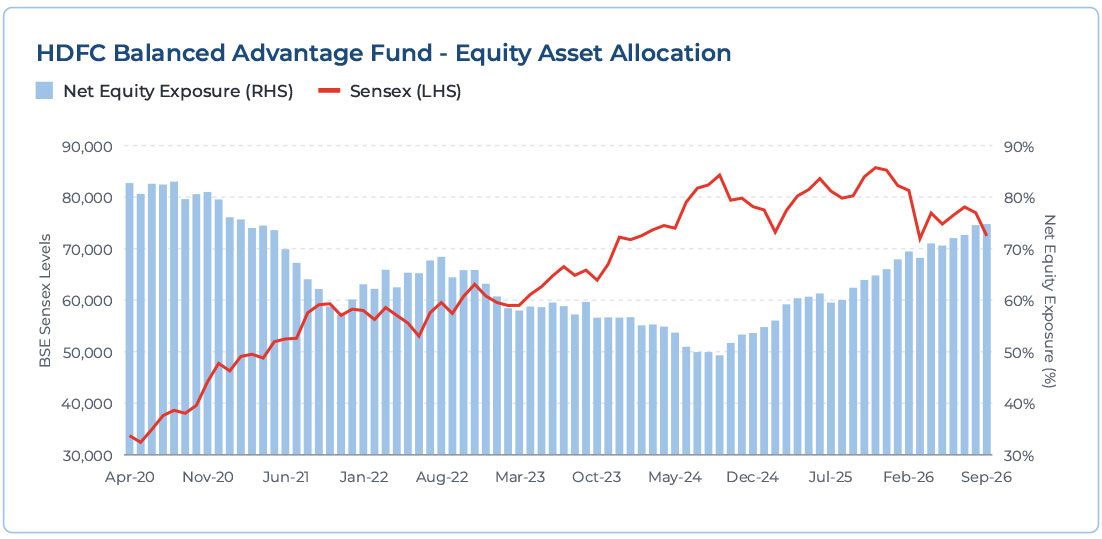
For further details on asset allocation of the Scheme, refer to the respective Scheme Information Document. Note: *The scheme maintainsequity allocation (hedged + unhedged) at minimum 65% all points of time. The above framework is broadly indicative and the fund managermay change the same depending on the market conditions. Data as on 30th September 2026
Another vital aspect to investing amid volatility is to possess the right temperament. Here are some tipsto deal with volatility –
It is not easy to time the market, and you cannot control the market forces. Therefore, it is important tostick to your investment plan, manage your temperament and be prepared to hold on to yourinvestments for a long period of time amid volatile markets. Make volatility your friend!
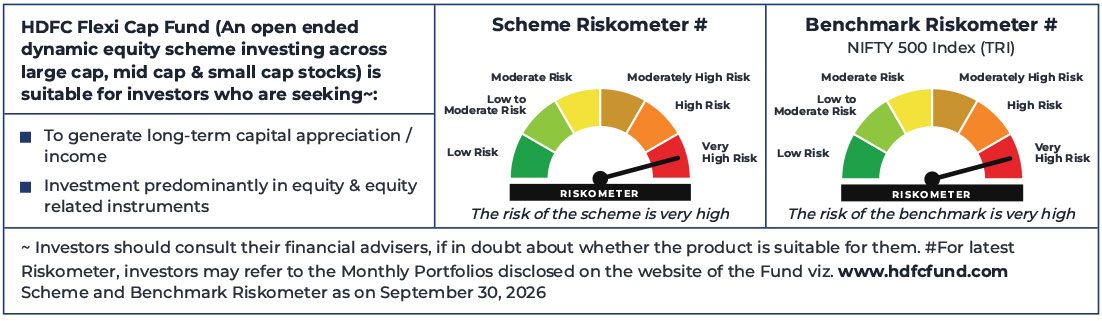
An open ended dynamic equity scheme investing across large cap, mid cap & small cap stocks.
A. SIP Performance^ - Regular Plan - Growth Option
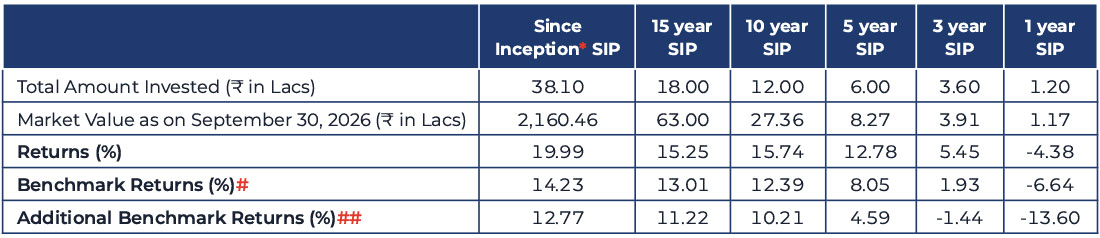
Assuming ₹ 10,000 invested systematically on the first Business Day of every month over a period of time. CAGR returns are computed afteraccounting for the cash flow by using XIRR method (investment internal rate of return) for Regular Plan - Growth Option. The above investmentsimulation is for illustrative purposes only and should not be construed as a promise on minimum returns and safeguard of capital. SIP -Systematic Investment Plan.
B. Performance^- Regular Plan - Growth Option
NAV as on September 30, 2026. ₹1,968.685 (per unit)
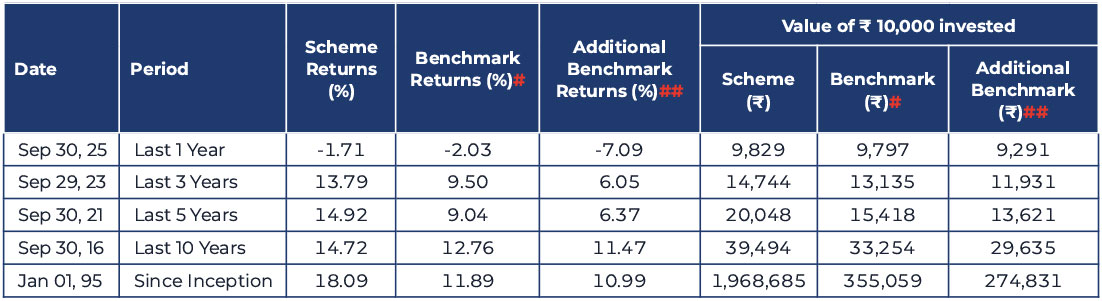
Common notes for the above table A & B: ^Past Performance may or may not be sustained in future and is not a guarantee of any futurereturns. HDFC AMC / HDFC MF is not guaranteeing or assuring any returns on investments in this Scheme. *Inception Date: January 1, 1995. Thescheme is co-managed by Mr. Amit Ganatra (since February 01, 2026) and Mr. Bhagyesh Kagalkar (since August 26, 2026). # NIFTY 500 Index (TRI).## Nifty 50 Index (TRI). The above returns are of Regular Plan – Growth Option. Returns greater than 1 year period are compounded annualized(CAGR). Load is not taken into consideration for computation of performance. Different Plans viz. Regular Plan and Direct Plan have a differentexpense structure. The expenses of the Direct Plan under the Scheme will be lower to the extent of the distribution expenses / commissioncharged in the Regular Plan. As NIFTY 50 TRI data is not available since inception of the scheme, additional benchmark performance is calculatedusing composite CAGR of NIFTY 50 PRI values from January 1, 1995 to June 29, 1999 and TRI values since June 30, 1999. Above returns are as onSeptember 30, 2026.
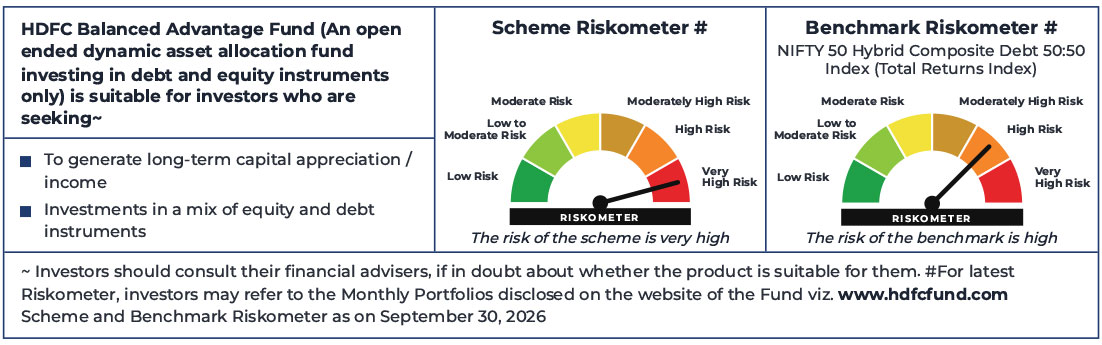
An open ended dynamic asset allocation fund investing in debt and equity instruments only.
A. SIP Performance^- Regular Plan - Growth Option
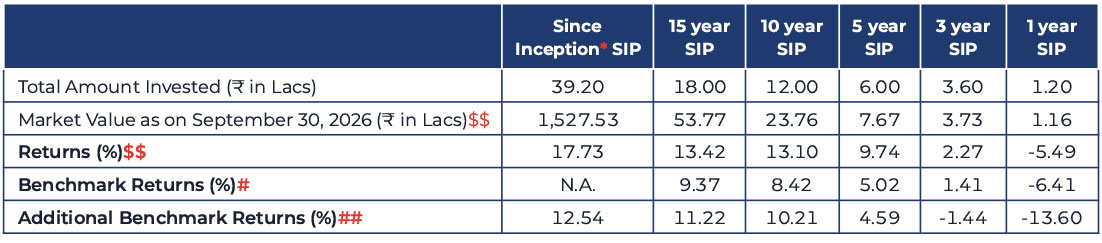
Assuming ₹ 10,000 invested systematically on the first Business Day of every month over a period of time. CAGR returns are computed afteraccounting for the cash flow by using XIRR method (investment internal rate of return) for Regular Plan - Growth Option. The above investmentsimulation is for illustrative purposes only and should not be construed as a promise on minimum returns and safeguard of capital. SIP -Systematic Investment Plan.
B. Performance^- Regular Plan - Growth Option
NAV as on September 30, 2026. ₹505.327 (per unit)
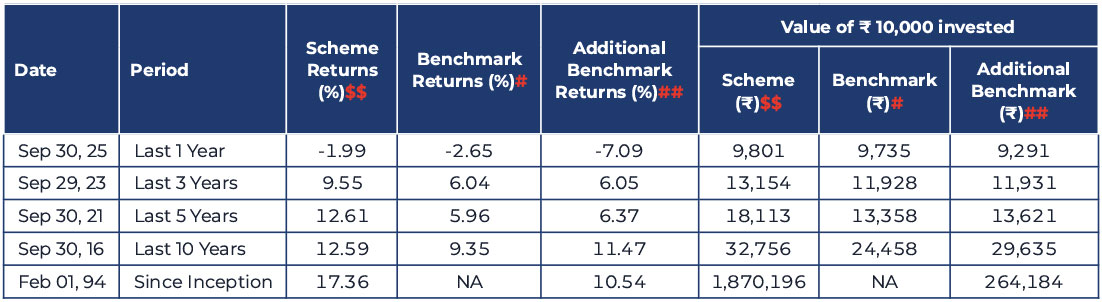
Common notes for the above table A & B: ^Past performance may or may not be sustained in future and is not a guarantee of any futurereturns. HDFC AMC / HDFC MF is not guaranteeing or assuring any returns on investments in this Scheme. *Inception Date: February 01, 1994. Thescheme is co-managed by Mr. Gopal Agrawal (Equity Portfolio) (since July 29, 2022), Mr Ihab Dalwai (Equity Portfolio) (since September 11, 2026),Mr. Arun Agarwal (Arbitrage Assets) (since October 6, 2022), Nandita Menezes (Arbitrage Assets) (since March 29, 2025) and Mr. Anil Bamboli (DebtPortfolio) (since July 29, 2022). # NIFTY 50 Hybrid Composite Debt 50:50 Index (Total Returns Index). ## Nifty 50 Index (TRI). $$ All Distributionsdeclared prior to the splitting of the Scheme into IDCW & Growth Options are assumed to be reinvested in the units of the Scheme at the thenprevailing NAV (ex-distribution NAV). As NIFTY 50 TRI data is not available since inception of the scheme, additional benchmark performance iscalculated using composite CAGR of NIFTY 50 PRI values from February 1, 1994 to June 29, 1999 and TRI values since June 30, 1999. Schemeperformance may not strictly be comparable with that of its Additional Benchmark in view of balanced nature of the scheme where a portion ofscheme’s investments are made in debt instruments. Returns greater than 1 year period are compounded annualized (CAGR). Load is not takeninto consideration for computation of performance. Different plans viz. Regular Plan and Direct Plan have a different expense structure. Theexpenses of the Direct Plan under the Scheme will be lower to the extent of the distribution expenses / commission charged in the Regular Plan.Returns as on 30 September, 2026
For performance of other funds managed by fund manager, Please Click here
Note: @@Effective close of business hours of June 1, 2018, HDFC Prudence Fund merged with HDFC Growth Fund (HDFC Balanced AdvantageFund after changes in fundamental attributes). As the portfolio characteristics and the broad investment strategy of HDFC Balanced AdvantageFund is similar to that of erstwhile HDFC Prudence Fund, the track record (i.e. since inception date, dividend history, etc.) and past performance oferstwhile HDFC Prudence Fund has been considered, in line with SEBI circular on Performance disclosure post consolidation/ merger of schemedated April 12, 2018.
Views expressed above are indicative and should not be construed as investment advice or as a substitute for financial planning.Due to the personal nature of investments, investors are advised to seek professional advice before investing.
MUTUAL FUND INVESTMENTS ARE SUBJECT TO MARKET RISKS, READ ALL SCHEME RELATED DOCUMENTS CAREFULLY.
Stay ahead with our insights
Did you find this interesting?
Your opinion matters - share your thoughts and help us improve.