
- Entering text into the form field will trigger a list of options
Trending Searches
- Invest / Login
Nifty Index Funds in India: What They Are and How to Get Started
Last Updated On: 26 Aug 2026 | Created On: 7 Aug 2025
5 min read
If you're looking for a simple, low-cost way to invest in the Indian stock market, Nifty Index Funds may be considered as a starting point. These funds mirror the performance of the indices. For example - Nifty 50 index, which consists of 50 of the largest and most actively traded stocks on the National Stock Exchange (NSE). In this guide, we’ll walk you through what Nifty Index Funds are, including the benefits, investment process, and key things to consider.
What is an index fund?
An index fund is an open-ended mutual fund scheme that is replicating/tracking a specified market index by investing primarily in the same securities and proportion as the underlying index. Such funds typically invest at least 95% of their total assets in securities of a particular index and aim to replicate index performance, subject to tracking error limits.
What Is a Nifty Index Fund?
A Nifty Index Fund is a type of mutual fund index scheme that replicates the Nifty index. It aims to generate returns that closely match the performance of the index by investing in the same companies in the same proportion.
Benefits of Investing in Index Fund schemes
- Low Cost: Lower expense ratio compared to actively managed funds
- Market-Linked Growth: Mirrors the performance of India’s companies as per index
- Transparency: Holdings are clearly defined by the index composition
- Beginner-Friendly: May be considered for first-time investors
- Diversification: A single index fund investment gives you exposure to 50+ companies (in case of Nifty 50) across multiple sectors. This reduces the risk of any single company's performance significantly impacting your portfolio, compared to investing in individual stocks.
How to consider investing in Index Fund schemes – Step-by-Step
You are also recommended to seek advice from financial advisor, for better understanding
Step 1: Choose Your Investment Platform
You can invest in index funds through two main routes:
- Direct with AMC: Visit the fund house's website to invest in their schemes directly. This gives you access to 'Direct Plans' which have lower expense ratios as there is no distributor commission.
- Through Platforms: Use aggregator platforms to compare and invest in index funds from multiple AMCs in one place. These platforms typically offer both Direct and Regular plans.
- Select a fund house that offers a Nifty index fund schemes Alternatively, use online platforms.
Step 2: Complete KYC (Know your customer)
- Submit PAN, Aadhaar, and address proof to complete your KYC
- Most platforms offer e-KYC for quick approval
Step 3: Select Investment Mode
- Lump Sum: One-time investment
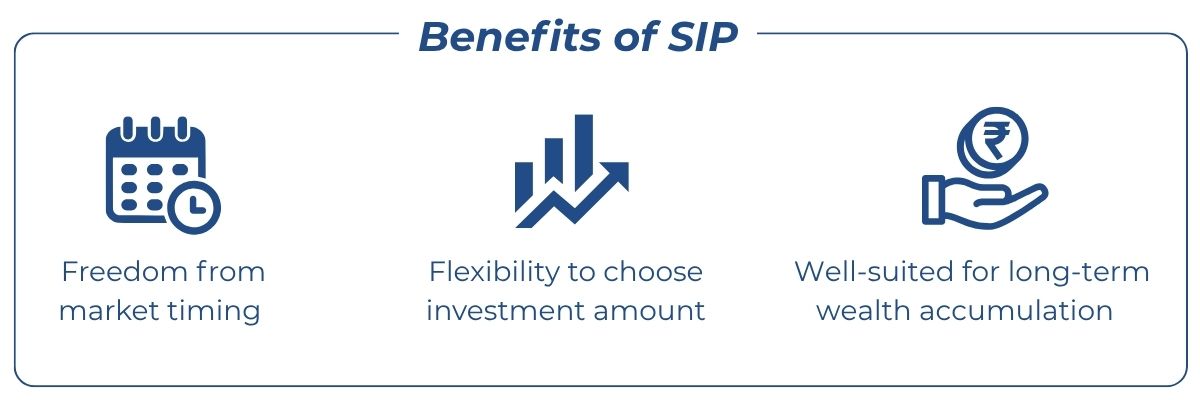
- SIP (Systematic Investment Plan): Invest a fixed amount regularly (monthly/weekly/daily/etc)
Step 4: Choose Fund Option
- Growth: Reinvests profits for compounding
- IDCW (Income Distribution cum Capital Withdrawal): Periodic payouts
Step 5: Monitor and Review Your Investment
- Review your index fund investment annually to ensure it remains aligned with your financial goals.
- Here's what to check: Track Performance vs Index: Verify that the fund's returns closely match the index. If tracking error increases significantly, it may indicate fund management issues.
- Check for Expense Ratio Changes: AMCs occasionally revise expense ratios.
- Rebalance if Goals Change: If your financial goals or risk tolerance change, adjust your portfolio accordingly. For example, you may shift from Nifty 50 to broader market indices or add debt funds as you near your goal.
How to Buy Index Fund Units on a Platform
- Log in to mutual fund website or investment platform
- Search for "Index Fund"
- Choose investment amount and payment mode
- Confirm the transaction and receive units in your folio
For better understanding, you may consult financial advisor basis your financial goals and risk appetite.
How to Choose an Index Fund
When selecting an index fund, focus on these two-key metrics, along with below 3 one must look at several other metrics before selecting an index fund.
- Low Expense Ratio: Index funds typically have expense ratios between 0.05% to 0.50% per year. Lower is better, as fees directly reduce your returns. Compare expense ratios across funds tracking the same index and choose the lowest-cost option.
- Low Tracking Error: This measure how closely the fund's returns match the index it tracks. The lower the tracking error, the more accurately the fund replicates index performance.
You may seek advice from a financial advisor to help you compare these metrics across different index fund schemes before making your investment decision.
Who Should Consider to Invest in Index Fund?
- Those looking for cost-efficient, diversified equity exposure
- First time investors
- People aiming for market-linked returns without active fund management
Taxation of Index Funds
- Tax treatment depends on whether the underlying index is equity-oriented or debt-oriented. Equity-oriented index funds are taxed as per equity mutual fund rules, while those tracking debt indices follow taxation applicable to debt mutual funds, in line with prevailing regulations.
- You are recommended to seek advice from tax advisors to understand latest tax regulations
Conclusion
Investing via index fund schemes can be an efficient way to participate in the growth of India’s top companies. With low costs, simplicity, and diversification, it’s good for both beginners and seasoned investors. Always evaluate scheme’s performance, expense ratio, and long-term track record before deciding.
Additional links:
What is a Mutual Fund? - Beginner's Guide to Investing
Who Should Invest in Index Funds?
How are Index Funds different from other Mutual Funds?
https://investor.sebi.gov.in/securities-howtoinvest.html
https://www.mutualfundssahihai.com/en/whats-easiest-way-get-started-mutual-fund-investments
FAQs
An index fund is an open‑ended mutual fund scheme that aims to replicate or track a specific market index by investing mainly in the same securities and in the same proportions as the underlying index. As per SEBI’s Master Circular, such funds typically invest at least 95% of their assets in index constituents and aim to replicate index performance, subject to tracking error.
Complete KYC and invest through any AMC website, investment app, or online platform.
No, only a mutual fund account or app login is needed to start an investment in an index fund
It is subject to market risks and scheme related risks. One must consult their financial advisor before taking any investment decision.
Yes, NRIs can invest through NRE/NRO accounts as per FEMA rules.
Nifty ETFs require a demat account and offer real-time trading; index funds don’t and are settled at end-of-day NAV.
Did you find this interesting?
Your opinion matters - share your thoughts and help us improve.
An Investor Education And Awareness Initiative
Visit https://www.hdfcfund.com/information/key-know-how to know more about the process to complete a one-time Know Your Customer (KYC) requirement to invest in Mutual Funds. Investors should only deal with registered Mutual Funds, details of which can be verified on the SEBI website (www.sebi.gov.in/intermediaries.html). For any queries, complaints & grievance redressal, investors may reach out to the AMCs and / or Investor Relations Officers. Additionally, investors may also lodge complaints directly with the AMCs. If they are not satisfied with the resolutions given by AMCs, they may raise complaint through the SCORES portal on https://scores.sebi.gov.in/scores-home/. SCORES portal facilitates investors to lodge complaint online with SEBI and subsequently view its status. In case the investor is not satisfied with the resolution of the complaints raised directly with the AMCs or through the SCORES portal, they may file any complaint on the Smart ODR on https://smartodr.in/login.
The information is for general purposes only and not an investment advice. Readers should seek professional advice before taking any investment related decisions.
MUTUAL FUND INVESTMENTS ARE SUBJECT TO MARKET RISKS, READ ALL SCHEME RELATED DOCUMENTS CAREFULLY