
- Entering text into the form field will trigger a list of options
Trending Searches
- Invest / Login
Retail Inflation plunges to record low: What it means for economy and investors?

Last Updated On: 20 Nov 2025
5 min read
What’s the Point?
- Inflation at a Record Low: India’s retail inflation dropped to 0.25% YoY, driven by food price deflation and GST cuts, opening room for further monetary policy easing.
- Economic Impact: Lower inflation supports consumption and strengthens the case for reduced borrowing costs, thereby aiding private capex revival even as nominal GDP growth moderates.
- Investor Implications: Low inflation and lower interest rates boost equity valuations. While nominal equity returns may moderate, real equity returns could remain strong supported by robust real GDP growth.
India’s retail inflation dipped to a record low with CPI (Consumer Price Index) registering a meagre 0.25% year on year increase. This is the lowest reading for the current CPI series and could be attributable to food price deflation and GST rate cuts. While low inflation paves the way for further easing of monetary policy, it has numerous other implications for the economy and investors.
Inflation at Record Low
October CPI inflation plunged to 0.25% from 1.4% in September, signaling a sharp disinflationary trend. The decline was driven by a contraction in food prices and the pass-through of GST rate cuts. Core inflation (CPI excluding food, beverages and fuel) edged up to 4.4% driven by a sharp rise in gold and silver prices (12.5% and 21.7% month-on month respectively) in October, offsetting some of the impact of the GST rate cuts.
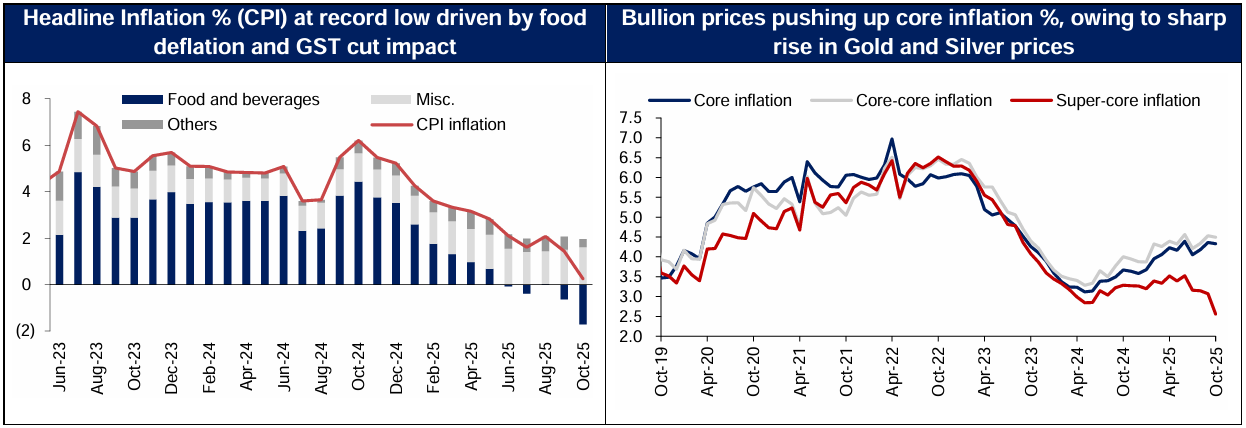
Core = CPI excluding food and fuel, Core-core = Core excluding petrol and diesel, Super Core = Core-Core excluding Gold and Silver
Reasons for Low Inflation Numbers
Food Price Deflation: A sharp 5% YoY drop in food prices led by fruits, vegetables, pulses, and oils drove the headline CPI lower. Seasonal supply abundance and government interventions amplified this trend.
GST Rate Cuts: Recent reductions across autos, electronics, clothing and select food items played a part. 4-wheelers, 2-wheelers witnessed a price reduction of 8.8% and 5.1% respectively between Aug-25 to Oct-25.
Favorable Base Effects: Last year’s elevated price levels magnified the YoY decline, making the current reading appear exceptionally benign. Headline inflation for corresponding month last year (Oct-24) was 6.2%.
Implications of low inflation on Economy
Consumption boost - Lower prices for essentials and GST cuts on discretionary items (autos, electronics) can stimulate demand, supporting volume growth for consumer sectors.
Lower borrowing costs to trigger capex - Benign inflation paves the path for further monetary policy easing thereby resulting in lower borrowing costs. This, along with pick-up in consumption can aid private capex revival
Lower Nominal GDP Growth even with a strong Real GDP growth - Nominal GDP Growth includes both real growth and price changes. When inflation falls, nominal GDP growth also slows, even if the economy’s actual output (real GDP) is strong. For example, if real GDP grows 7% and prices rise 5%, nominal GDP is about 12%. If prices rise only 2%, nominal GDP drops to around 9%.
What it means for Investors?
- Low inflation combined with low interest rates tend to be a tailwind for equity valuations. When rates fall, the discount rate used in valuation models declines, making future cash flows more valuable today and pushing up intrinsic valuations
- Equity returns in the long run tend to track nominal GDP growth because corporate revenues and earnings are closely linked to the size of the economy in nominal terms. When inflation is high, nominal GDP is higher, thereby boosting revenue growth even without significant volume gains. Conversely, in a low-inflation environment, nominal GDP growth slows, even if real GDP remains robust. As a result, equity returns are likely to normalize closer to nominal GDP growth rates, which could be lower than historical averages, thereby necessitating realistic return expectations.
- While nominal returns may be lower than historical average, real returns could continue to be strong if the Real GDP growth is robust. In fact, if the real returns stay the same even as nominal returns moderate, investors could be better off on a real post-tax basis (adjusted for tax and inflation) as taxes are levied on Nominal returns.
Conclusion: India’s record-low inflation is a positive macro-economic development, creating space for policy easing and reinforcing economic stability. While a modest rebound is likely as base effects fade, inflation is expected to stay benign. Lower prices and GST cuts should support consumption, while cheaper borrowing costs can accelerate private capex. With inflation expected to settle at relatively lower levels compared to historical average; nominal GDP growth may soften. Strong fundamentals though could keep real growth intact. For investors, this means real equity returns could remain healthy even if nominal returns moderate over time.
Sources: Bloomberg, CMIE and other publicly available information
About Tuesday’s Talking Point (TTP): TTP is an effort by HDFC AMC to guide key conversations in the Indian financial markets and investing ecosystem. We aspire to do this by providing relevant facts, along with our perspective on the issue at hand. Please provide your feedback at this link: https://forms.office.com/r/Cr8JNjMGWk
Disclaimer: Views expressed herein are based on information available in publicly accessible media, involve known and unknown risks and uncertainties that could cause actual results, performance, or events to differ materially from those expressed or implied herein. The information herein is for general purposes only. Stocks/Sectors/Views referred are illustrative and should not be construed as an investment advice or a research report or a recommendation by HDFC Mutual Fund (“the Fund”) / HDFC Asset Management Company Limited (HDFC AMC) to buy or sell the stock or any other security. The Fund/ HDFC AMC is not indicating or guaranteeing returns on any investments. Past performance may or may not be sustained in the future and is not a guarantee of any future returns. The recipient(s), before taking any decision, should make their own investigation and seek appropriate professional advice.
MUTUAL FUND INVESTMENTS ARE SUBJECT TO MARKET RISKS, READ ALL SCHEME RELATED DOCUMENTS CAREFULLY.
Stay ahead with our insights
Did you find this interesting?
Your opinion matters - share your thoughts and help us improve.