
- Entering text into the form field will trigger a list of options
Trending Searches
- Invest / Login
New CPI Series: A reset towards a more representative Inflation measurement

Last Updated On: 18 Feb 2026
5 min read
What’s the Point?
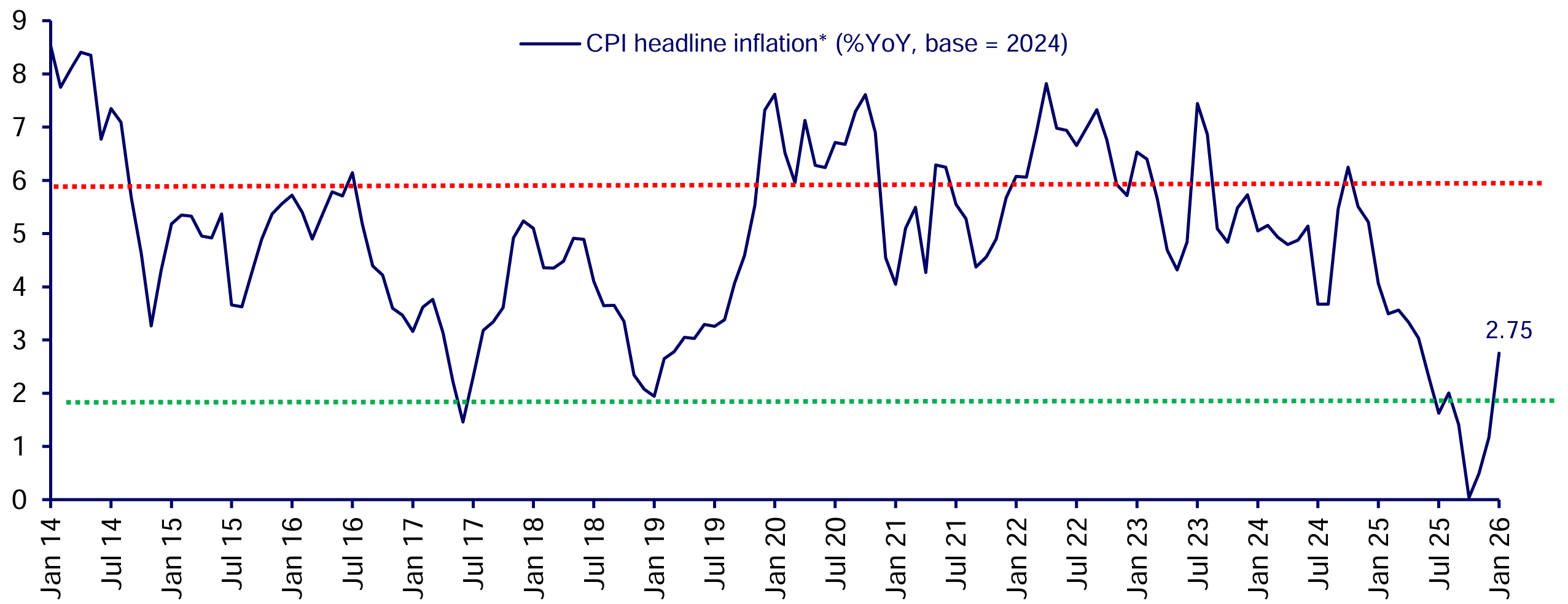
First Print of new CPI at 2.75%: The new 2024-base Consumer Price Index (CPI) begins within the RBI’s 2–6% tolerance band, indicating contained price pressures and limited immediate policy urgency.
Structural weight reset: In the new CPI series, food’s share declines materially, while services and discretionary categories gain prominence, making inflation measurement more aligned with evolving consumption patterns.
Greater policy clarity: A more representative basket reduces distortion from transient food shocks and improves the RBI’s ability to assess persistent, demand-driven inflation trend.
India’s new Consumer Price Index (CPI) series recorded its first reading at 2.75% for January 2026, marking an important statistical and policy milestone. While the headline number remains benign, the broader significance lies in what the new series represents i.e. a recalibration of how inflation is measured in an economy that has structurally evolved over the past decade. What’s worth noting is that this is not merely a routine base revision. It is a revision that better aligns inflation measurement with contemporary consumption realities, making it more reflective of demand conditions and less susceptible to temporary distortions.
Why the CPI Series has been changed?
The earlier CPI series was anchored to a 2012 base year. Over the past decade, India’s consumption structure has shifted meaningfully. GST stabilization, rising formalization, deeper financial inclusion, urbanization, digital commerce penetration and growing discretionary income have altered household spending patterns.
Food, once the dominant component of expenditure, now occupies a relatively smaller share. Spending on housing, healthcare, mobility, communication, recreation and personal services has steadily increased. When the consumption basket does not evolve in line with such changes, inflation measurement risks overstating some pressures while understating others. In view of this, the new CPI series realigns weights to reflect current spending behaviour.
Why is CPI Series important for Monetary Policy decisions?
CPI anchors India’s inflation-targeting framework, guiding the RBI’s monetary policy and interest rate decisions within the 2–6% tolerance band. It shapes policy rates, borrowing costs, liquidity and fiscal planning. A credible CPI helps maintain price stability and plays a key role in maintaining macroeconomic stability and anchoring expectations.
How has the CPI changed?
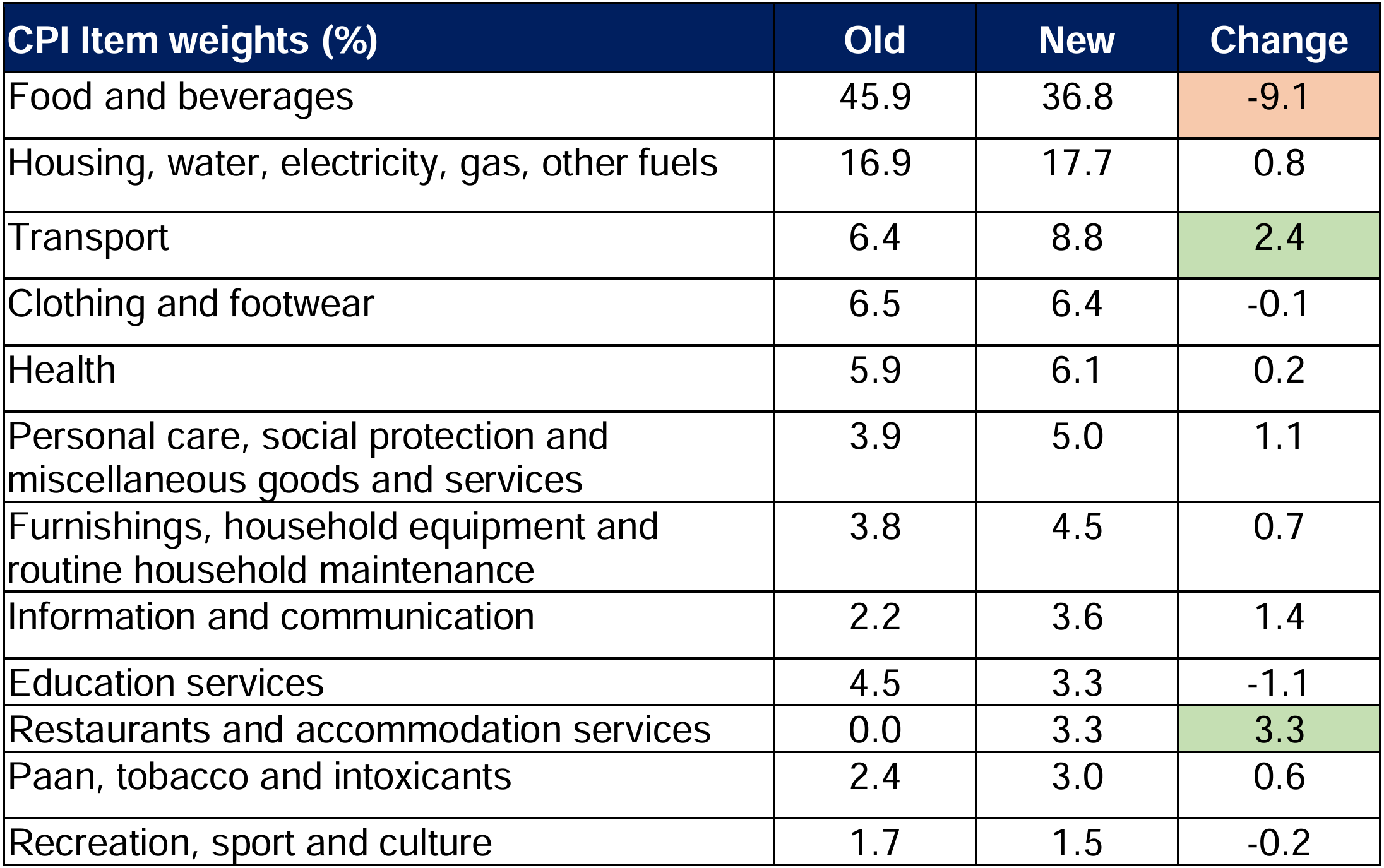
What the first print of new CPI series reveals?
- The 2.75% inflation reading suggests inflation pressures remain contained. Food inflation was about 2.1% year on-year. Core inflation stood near 3.4%. Nearly 82% of sub-components recorded sub-4% inflation.
- The modest uptick in headline inflation was partly driven by precious metals and certain vegetables, rather than broad-based demand pressures. Excluding precious metals, headline inflation was only 1.9%.
- With food inflation benign, core pressures stable and the majority of components below 4%, the near-term inflation outlook appears manageable.
Conclusion
The launch of the 2024-base CPI series, beginning with a 2.75% print, represents a meaningful modernization of India’s inflation architecture. By reducing food dominance, increasing services representation, expanding item coverage and incorporating evolving consumption trends, the index now better reflects the structure of a transforming economy. Importantly, the change does not imply structurally higher or lower inflation. Rather, it alters the composition of what inflation measures. In an economy undergoing steady structural transformation, accurate inflation measurement is foundational. The revised CPI strengthens the credibility of India’s inflation-targeting framework.
Sources: *CLSA, Bloomberg and other publicly available information
Disclaimer: Views expressed herein are based on information available in publicly accessible media, involve known and unknown risks and uncertainties that could cause actual results, performance, or events to differ materially from those expressed or implied herein. The information herein is for general purposes only. Stocks/Sectors/Views referred are illustrative and should not be construed as an investment advice or a research report or a recommendation by HDFC Mutual Fund (“the Fund”) / HDFC Asset Management Company Limited (HDFC AMC) to buy or sell the stock or any other security. The Fund/ HDFC AMC is not indicating or guaranteeing returns on any investments. Past performance may or may not be sustained in the future and is not a guarantee of any future returns. The recipient(s), before taking any decision, should make their own investigation and seek appropriate professional advice.
MUTUAL FUND INVESTMENTS ARE SUBJECT TO MARKET RISKS, READ ALL SCHEME RELATED DOCUMENTS CAREFULLY.
Stay ahead with our insights
Did you find this interesting?
Your opinion matters - share your thoughts and help us improve.