India’s top automobile manufacturers recorded their strongest-ever Diwali season, fueled by recent GST rate cuts, easing interest rates, and buoyant consumer sentiment throughout the festive period. Between Navratri and Diwali 2025, total auto registrations reached 33.57 lakh units, a 17% increase over 2024 with most segments witnessing growth better than that witnessed in the festive season last year.

- Entering text into the form field will trigger a list of options
Trending Searches
- Invest / Login
Festive Cheer Lights Up India’s Consumption to Pave Way for Earnings Recovery

Last Updated On: 29 Oct 2025
5 min read
What’s the Point?
- Record consumption: India’s festive trade during Diwali 2025 hit a record ₹6.05 lakh crore, marking a 25% YoY growth driven by multiple favourable factors.
- Multiple drivers: Favourable macro tailwinds like GST reforms, benign inflation, lower interest rates and tax relief boosted disposable incomes and purchasing power across households driving consumption boom.
- Demand-led growth: With capex momentum moderating, India’s growth engine is shifting toward consumption, which could catalyse earnings recovery, reignite private capex and spur GDP growth.
India witnessed record festive sales of Rs 6.05 trillion (goods and services combined) during Diwali 2025, which is the highest-ever festive turnover in the country’s retail history and a 25% jump over last year. Every major economy has its flagship consumption window, like the Black Friday and Christmas for US, Singles’ Day (11.11) for China, Golden Week for Japan etc. For India, Navratri-Diwali is this crucial window and this year’s season gained even greater significance with the launch of GST 2.0 ahead of the festive season on 22nd September.
India’s Festive Season in numbers
India’s festive trade during Navratri to Diwali 2025 hit a record ₹6.05 lakh crore, comprising ₹5.4 lakh crore in goods and ₹65,000 crore in services, a 25% increase over 2024. This surge was broad-based and inclusive with rural India contributing 28% of total trade, indicating rising rural purchasing power
FMCG accounted for 12 percent of total sales, followed by gold and jewellery (10 percent), electronics and electricals (8 percent), consumer durables (7 percent) and ready-made garments (7 percent),
E-commerce Order volumes rose 24% YoY, with Quick Commerce apps seeing a 120% jump. Tier II and III cities contributed 55% of orders, reflecting deeper digital penetration.
Nearly 50 lakh temporary jobs were created across logistics, packaging, hospitality, and delivery services. Trader and consumer sentiments were reported at a decade high, with the Trader Confidence Index (TCI) at 8.6 out of 10 and the Consumer Confidence Index (CCI) at 8.4 out of 10.
Autos in fast lane
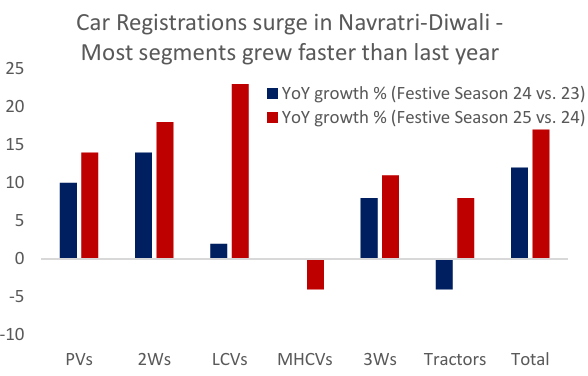
India’s automotive industry is a cornerstone of the nation’s economic growth, contributing ~7% to India’s GDP and ~50% of manufacturing GDP and revival of demand bodes well for the economy.
Key Drivers Behind the Surge
GST 2.0 Reforms - The simplification of GST into a two-slab structure (5% and 18%), along with a 40% rate for sin/luxury goods, has significantly boosted affordability. As per Confederation of All India Traders (CAIT) survey, over 72% of traders linked higher sales to these reforms, which also eased compliance.
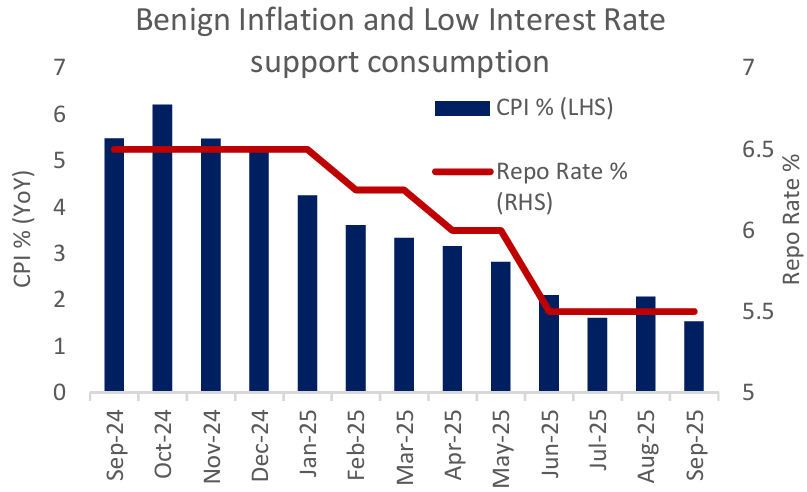
Lower Interest Rates and Income Tax Relief - An accommodative monetary stance by the RBI has ensured ample liquidity in the system. The resulting decline in borrowing costs has aided discretionary purchases like automobiles and appliances. Meanwhile, income tax relief announced in the Union Budget has also provided incremental disposable income to middle-class households.
Revival of Rural Economy - India’s consumption rebound was not confined to metros. A healthy monsoon, robust farm output and GST cuts on Agricultural equipment/inputs lifted rural incomes and sentiment. As a result, Tier II and Tier III towns became key drivers of festive demand contributing nearly 28% of total trade this season.
Demand-led growth to drive the economy
India’ s post-pandemic recovery was initially driven by supply-side interventions viz. government capex, infrastructure push and PLI schemes. However, with private investment still tepid and government spending now moderating, the capex momentum has slowed down. Uncertain trade environment adds to the overhang on private capex. In this scenario, a demand-side revival is critical. Consequently, consumption which accounts for ~60% of the GDP has become a focus area with numerous reforms on this front. A robust consumption can spur corporate earnings, improve capacity utilization and eventually reignites private capex.
Conclusion: India’s subdued household consumption in recent years prompted policymakers to deploy a combination of fiscal and monetary measures to revive demand. The record-breaking festive sales signal that these efforts are bearing fruit, marking a shift towards demand-led growth. For investors, this trend underscores the potential of consumption-oriented equity funds to capture India’s next growth phase.
Sources: Bloomberg, CMIE and other publicly available information
PV: Passenger Vehicles, 2Ws: 2 Wheelers, 3Ws: 3 Wheelers, LCVs: Light Commercial Vehicle, MHCV: Medium and Heavy Commercial Vehicles, PLI: Production Linked Incentive
Disclaimer: Views expressed herein are based on information available in publicly accessible media, involve known and unknown risks and uncertainties that could cause actual results, performance, or events to differ materially from those expressed or implied herein. The information herein is for general purposes only. Stocks/Sectors/Views referred are illustrative and should not be construed as an investment advice or a research report or a recommendation by HDFC Mutual Fund (“the Fund”) / HDFC Asset Management Company Limited (HDFC AMC) to buy or sell the stock or any other security. The Fund/ HDFC AMC is not indicating or guaranteeing returns on any investments. Past performance may or may not be sustained in the future and is not a guarantee of any future returns. The recipient(s), before taking any decision, should make their own investigation and seek appropriate professional advice.
MUTUAL FUND INVESTMENTS ARE SUBJECT TO MARKET RISKS, READ ALL SCHEME RELATED DOCUMENTS CAREFULLY.
Stay ahead with our insights
Did you find this interesting?
Your opinion matters - share your thoughts and help us improve.