
- Entering text into the form field will trigger a list of options
Trending Searches
- Invest / Login
Corporate Capex – A Metric seeing a Broad-based Recovery

Last Updated On: 16 Dec 2025
5 min read
What’s the Point?
- In its Board Meeting held on December 10, 2025, Tata Steel announced its latest expansion plan, centred on scaling up the Neelachal Ispat Nigam Ltd. unit. The company aims to add 4.8 Million Tonnes Per Annum (MTPA) of capacity, taking it to 5.8 MTPA.
- While this announcement is positive for supporting India’s economic growth, its real importance lies in its fitment in India’s evolving capex story. The uncertain global environment over the past year has affected corporate capex, with TTM (Trailing Twelve Month) end-Sep’25 listed corporate capex rising only 6.3% YoY – well below the 20% average annual growth recorded between FY22 and FY25.
- Having said that, listed corporate capex, which is approaching ₹12 lakh crore as of Sep’25, is seeing a broad based recovery. In era of de-globalisation and inward-looking policies, multiple nations are moving towards self reliance in core sectors. Hence, this trend could be a fillip to the investment rate, as India builds domestic capacity in various areas such as energy, defence, rare earth, infrastructure, manufacturing and digital infrastructure.
“Twin Balance Sheet” Challenge – Now behind us
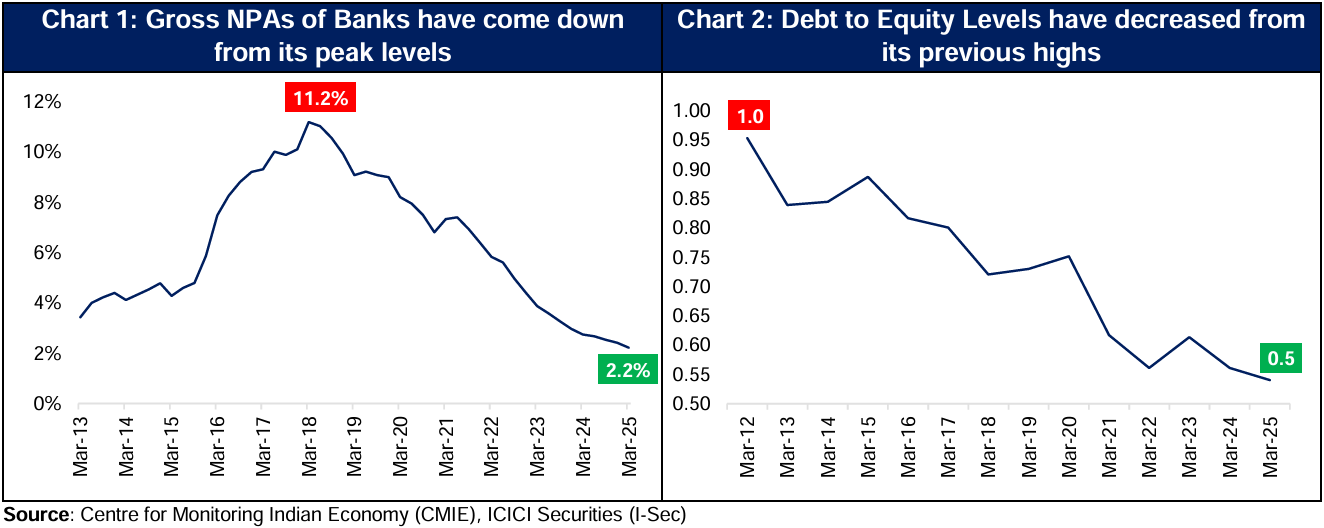
After 2015, the Reserve Bank of India (RBI) conducted an Asset Quality Review that forced banks to reveal large hidden Non-Performing Assets (NPAs), thereby reducing the credit quality of their balance sheets. At the same time, highly leveraged corporates – especially in infrastructure, power and steel – were struggling with stalled projects and poor cash flows, leaving them in a difficult position to service debt or invest, and intensifying stress across both sides of the system.
This combination of strained borrowers and capital-starved lenders created a credit freeze that slowed investment and growth. However, the Government and RBI clean-up measures gradually restored balance sheet health and helped revive credit flow and corporate investment.
Recovery in Corporate Capex becoming more Broad-based – Which Sectors?
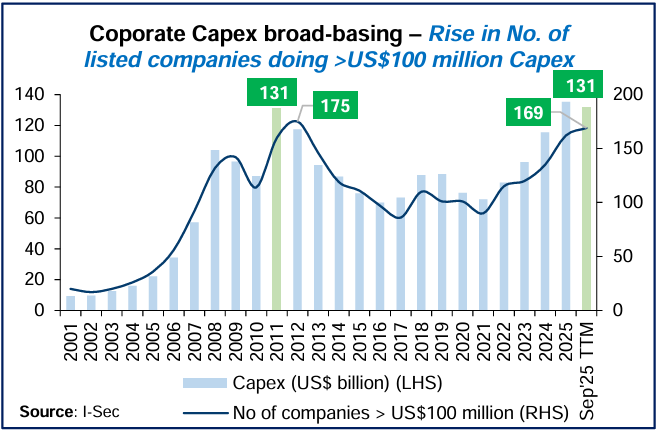
Capex expansion is becoming broad-based, with the count of companies with >US$100 million annual capex and the cumulative capex rising to 169 and US$131 billion by end of Sep’25 respectively, which is close to the levels last witnessed in 2011-12. During this time, the corporate capex expansion has predominately been in sectors like industrials, autos, metals and consumption, energy, utilities and healthcare.
Fiscal and Monetary Policy Actions could aid further expansion of Corporate Capex
Sluggish consumption has softened corporate capex momentum in the recent past. However, recent government measures, such as the GST overhaul in September 2025, are expected to revive demand, improve capacity utilisation and, in turn, create a more supportive environment for a sustained recovery in corporate capex. In addition, repo rate cuts implemented in CY25 could provide a further tailwind by lowering borrowing costs, improving project viability and creating more favourable conditions for the next leg of corporate capex expansion.
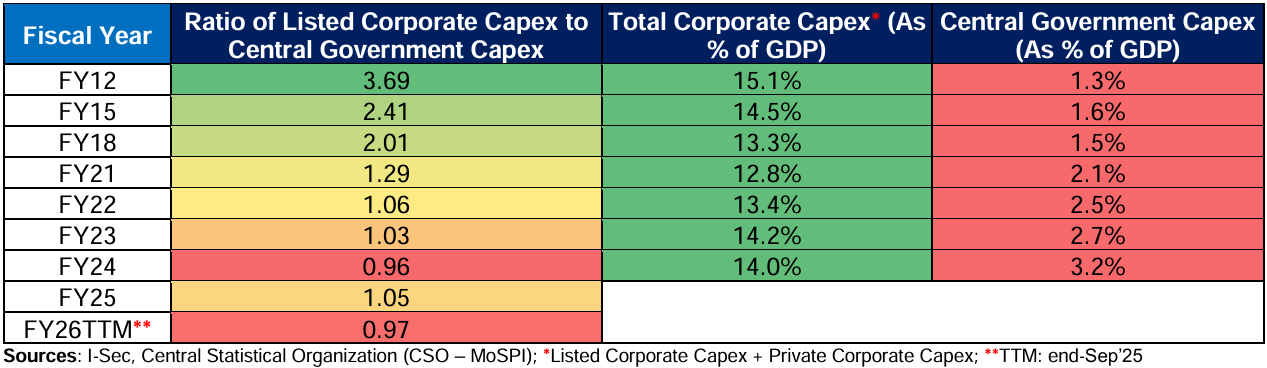
Key Takeaway: The gap between Central Government capex and listed corporate capex has been narrowing for over a decade from its peak in FY09. Over FY21-FY25, Central Government capex grew much faster – average 26% YoY compared with 15% for listed corporates. However, as the table shows, Central Government capex forms only 3.2% of nominal GDP (FY24), while total corporate capex (listed + unlisted) accounts for 14%. This underscores the need for a meaningful pickup in corporate investment, as sustained GDP growth and India’s long-term self-reliance also depends on the scale and momentum of corporate capex than Government capex alone.
Sources: Tata Steel Press Release, I-Sec, RBI, CSO (MoSPI) and other publicly available information
About Tuesday’s Talking Point (TTP): TTP is an effort by HDFC AMC to guide key conversations in the Indian financial markets and investing ecosystem. We aspire to do this by providing relevant facts, along with our perspective on the issue at hand. Please provide your feedback at this link: https://forms.office.com/r/Cr8JNjMGWk
Disclaimer: Views expressed herein are based on information available in publicly accessible media, involve known and unknown risks and uncertainties that could cause actual results, performance, or events to differ materially from those expressed or implied herein. The information herein is for general purposes only. Stocks/Sectors/Views referred are illustrative and should not be construed as an investment advice or a research report or a recommendation by HDFC Mutual Fund (“the Fund”) / HDFC Asset Management Company Limited (HDFC AMC) to buy or sell the stock or any other security. HDFC AMC is not indicating or guaranteeing returns on any investments. Past performance may or may not be sustained in the future and is not a guarantee of any future returns. The recipient(s), before taking any decision, should make their own investigation and seek appropriate professional advice.
MUTUAL FUND INVESTMENTS ARE SUBJECT TO MARKET RISKS, READ ALL SCHEME RELATED DOCUMENTS CAREFULLY.
Stay ahead with our insights
Did you find this interesting?
Your opinion matters - share your thoughts and help us improve.