- Entering text into the form field will trigger a list of options
Trending Searches
- Invest / Login
When Asset Allocation is Key, We Make it Easy for You!

Last Updated On: 8 Aug 2025
What do you think is the key takeaway from the chart below?
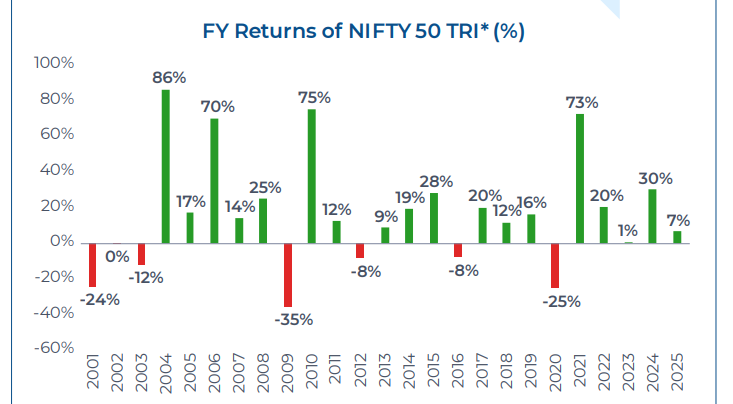
Source: www.niftyindices.com, Data from March 30, 2000 to March 28, 2025. Past performance may / may not be sustained in the future and is not a guarantee of any future returns. HDFC AMC/Mutual Fund is not guaranteeing or promising or forecasting any returns. *TRI = Total Returns Index.
There are a few takeaways from the yearly returns data of Nifty 50. The first one being, yearly returns are not steady, but positive instances are more than negative ones. Also, one cannot accurately time the market, and must try to stay invested for long. The most important lesson, we believe, is that equities alone may not be enough for your overall portfolio.
What strategy must one adopt to manage this volatility?
The answer lies in Asset Allocation!
Consider a comparison between investing in individual asset classes (say, Equity, Debt and Gold) vs opting for asset allocation (which comprises varying proportions of the aforementioned individual asset classes). Equity offers a potential to generate higher returns versus other asset classes, but with a much higher volatility. Combining multiple asset classes helps improve the risk-adjusted returns for an investor.
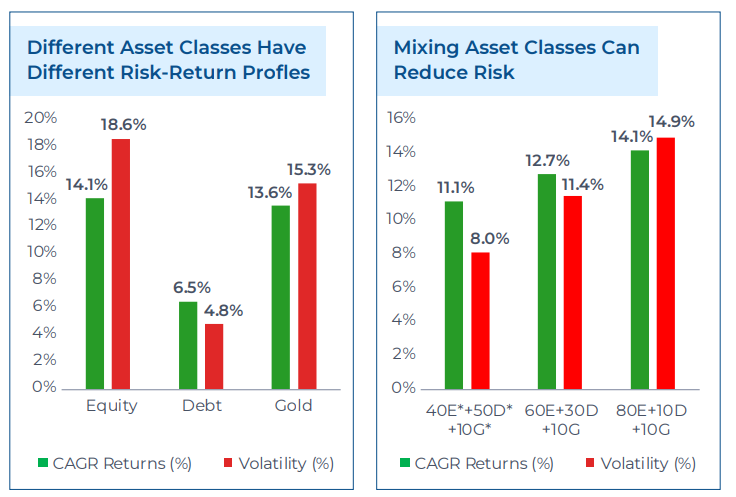
Source: www.niftyindices.com, World Gold Council. Data from March 31, 2002 to July 31, 2025. Returns are compounded annual in nature. Data used for asset classes: Equity – NIFTY 50, Debt – NIFTY 10-year Benchmark G-Sec, Gold – Spot Rate ₹/10 Grams. Monthly portfolio rebalancing assumed. Standard Deviation calculated using daily returns. The above analysis is based on back-testing of the above-mentioned asset classes. Past performance may / may not be sustained in the future and is not a guarantee of any future returns. HDFC AMC/Mutual Fund is not guaranteeing or promising or forecasting any returns. Comparison with Gold has been given solely for the purpose of understanding and illustrative purpose. The above combinations are for illustrative purpose. Investors are requested to take professional advice while making investment decisions. *E: Equity, D: Debt, G: Gold
Asset Allocation incorporates an investor’s investment objective, risk appetite, investment horizon and investment constraints while choosing an asset class. The chosen asset classes are assembled in varying proportions as per the objective.
But, Investors Often Face Difficulty When it Comes to Asset Allocation on their Own! The Solution?
When Asset Allocation is Key, We Make it Easy For You!
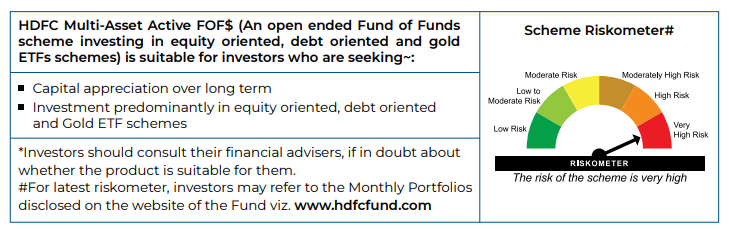
An investment strategy that invests across asset classes may help manage extremities of poor portfolio performance. Investors can consider investing in the HDFC Multi-Asset Active FOF. A Fund of Fund (FoF) approach allows investors to gain diversified exposure to various asset classes through a single fund by relying on the expertise of professional Fund Managers.
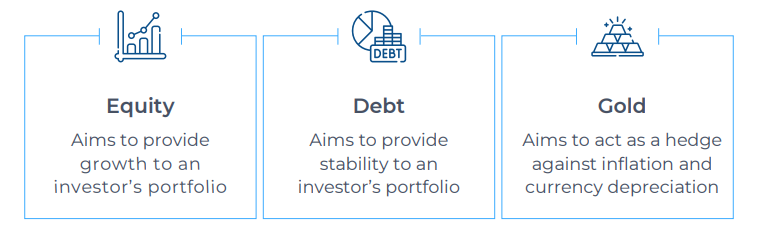
The scheme will invest in:

Conclusion
Opting for an asset allocation strategy may reduce overall portfolio risk while yielding optimal returns. Low correlation among asset classes may lead to portfolio diversification. The risk in this strategy is that if due to extreme market uncertainty, the correlation among asset classes increases, it may lead to sub-optimal return generation.
Investors in the Scheme shall bear the recurring expenses of the Scheme in addition to the expenses of other schemes in which this Fund of Funds scheme makes investment (subject to regulatory limits).
$Effective from May 02, 2025, the name of HDFC Asset Allocator Fund of Funds has been changed to HDFC Multi-Asset Active FOF, and the Benchmark of the Fund has been changed to 50% NIFTY 50 TRI + 40% NIFTY Composite Debt Index + 10% Gold derived as per regulatory norms. For more details, please refer to the Addendum dated April 22, 2025: Change in Name and Benchmark Index of Select Schemes
Views expressed above are indicative and should not be construed as investment advice or as a substitute for financial planning. Due to the personal nature of investments, investors are advised to seek professional advice before investing.
MUTUAL FUND INVESTMENTS ARE SUBJECT TO MARKET RISKS, READ ALL SCHEME RELATED DOCUMENTS CAREFULLY.
Stay ahead with our insights
Did you find this interesting?
Your opinion matters - share your thoughts and help us improve.